Showing posts with label #recession2020. Show all posts
Showing posts with label #recession2020. Show all posts
Friday, October 9, 2020
Are we in the Next Great Depression?
Have we begun "The Next Great Depression?" Personally, I think we are in what will ultimately be a Great Depression, and we have crossed the threshold (10%+ GDP drop) that makes this offically an economic depression. But will things get as grim as this video depicts? I'll let you decided. This is a really depressing comparison between our world today, and the Great Depression of the 1930's.

Sunday, September 6, 2020
It's Labor Day weekend 2020: So what IS the REAL unemployment rate?

The 8.4% number is considered the "official" unemployment rate by Washington and the major media, it's the red line is this chart above. The reason is because it's the lowest rate, and it looks the best in TV and web reports. That 8.4% number is the U-3 number, for August 2020, from the U.S. Bureau of Labor Statistics (BLS). The problem with the U-3 unemployment number is that is doesn't include a lot of people who are not working, in fact doesn't include most of the people who are not working. In any "normal" time, unemployment at 8.4% would be catastrophic, economists want to see real unemployment at about 3% to 4%. So this U-3 more than number is double that. That's bad, horrible, in fact, in "normal times." But in a year when close to 50 million lost their jobs in a few months, most of them"temporarily" lost, 8.4% is LESS BAD, than the 15% a couple of months ago. The problem is, the U-3 number doesn't count about 3/4 of the U.S. adults who are actually not working.
There's another unemployment number, the U-6 number, and it's just as official as the U-3 number, and it's also put out by the BLS, that's the U-6 unemployment rate. The U-6 number dropped to 14.24% for August 2020, and that's the gray line above. What's the difference? The U-3 number basically counts people with traditional jobs who applied for unemployment insurance, that's all. The U-6 number takes that, and adds in people who are forced to work part time, because they can't find full time work, and people who have been discouraged from looking for work in immediate future, they don't think they can find any job soon. So this U-6 number, makes more sense, it's every bit as official as the U-3 number, and it tells us that over 14% of working people in the U.S. aren't working right now.
So what's that scary blue line above, that figures U.S. unemployment at 27 to 28%? That's the number by this website, shadowstats.com, and it takes the U-6 number, and adds in the "long term discouraged" workers, those are American adults of working age, who simply have completely given up looking for work altogether. They either don't think they can ever find a job again, or they have some way to survive without working.
The total American "workforce," is just under164 million people, out of the total 328 million (+/-) Americans. The shadow stats number is the closest to actually showing us how many of the people in the "workforce" are not working right now. So if we figure 27% of the "workforce" isn't working right now, that's 44.5 million American adults NOT working, out of 164 million. If you go through all the actual Bureau of Labor Statistics numbers, you'll find that well over 44.5 million American adults are NOT working right now. Here, dig through the numbers yourself. Here's the official stats for August 2020. If you look at the "participation rate" on this chart for August 2020,it says 61.7%. That means 38.3% of the "American workforce" isn't working right now. Some of those are housewives who take care of the kids, or dads doing that job, and some others who don't work a job or business. So the shadowstats number, roughly 27%, is the closest to a "people who should be able to find work, but can't" number, which is what the unemployment number is supposed to be.
This number doesn't include gig workers, and microbusinesses (1 person business), and small businesses that have lost a lot of their income, but are technically working. So even the 27% number doesn't really give us a good look at how bad of a hit the economic crash (which started with the Repo market in Sept. 2019) AND the Covid-19 shutdown, have hit real world working (and potentially working) Americans.
There's a large group, 7 million + men, and a growing number of women, American adults, who don't even try to find work. This group seems to be living largely on YOUR tax dollars, permanently, getting government checks, from Social Security Disability and other sources. The only person who has looked into this growing group is Nicolas Eberstadt, in his book, Men Without Work. This is a big part of the long term unemployed, and pretty much no one is studying this major American issue right now. And we really need to. Here's a short news clip on his work (February 2017), and here's a full speech by Nicolas Eberstadt, explaining this issue in detail, from 2017.
Friday, August 28, 2020
Prediction: The next stock market collapse will come BEFORE the election
What goes up, must come down. A little Blood, Sweat & Tears (lots of tears), for you today.
I'm back from a few days of not thinking about the economy, and the depression we are now 11 months into. Ip'm utting my ass on the line again, with some hard number, hard date predictions. Here they are.
The Nasdaq will drop below 8,000 points BEFORE November 3rd, 2020
The Dow Jones Industrial Average will drop below 20,000 points BEFORE November 3rd, 2020.
The S&P 500 will drop below 2,500 points BEFORE November 3rd
Call if the Trump Dump, if you need a catchy nickname. Or not, he didn't cause this, he just helped make it worse.
Will these ridiculous predictions come true? Of course not, as anyone in the market right now. "It will never go down!" Right? We'll see.
By the way, here are my last set of ridiculous predictions. No one in any serious position of expertise thought ANY of these would happen in 2020 when I wrote this post. Three of the nine predictions have come true, and they were all for calendar year 2020, so there's four months left to see if any of the others happen. Once again, let's hope I'm wrong...
Remember to vote for someone, for every office open, on November 3rd.
Saturday, August 22, 2020
Warren Buffet sold all his Goldman Sachs stock? But they run the world...
This video talks about the recent stock trades of Berkshire Hathaway, the investment business headed by legendary investor Warren Buffet, and his lesser known partner, Charlie Munger. If you go to about 1:12 in the video, you can pause it and read the list.
Way back in the early 1990's, as a geeky, 20-something, BMX freestyler guy, I wanted to be ridiculously rich. Like most young guys, I thought that if I could find a way to become rich quickly, I could avoid working lame jobs, and do what I wanted all day, which was mostly riding my BMX bike.
Unlike most young guys, I started reading and learning about real estate, money, economics, and all things money related. One thing I began to do was study the Forbes 400 magazine every year. That was a pretty new thing back then, and had been coming out annually for 6 or 8 years when I first picked on up. The Forbes 400 is an issue of Forbes magazine where they listed the 400 richest people in the United States, how much those people were worth, and two or three paragraphs about each person. It comes out each fall. Reading the Forbes 400, year after year, was incredibly enlightening in a financial sense. First I learned that about 1/3 of the 400 richest people inherited their money. So the first lesson, if you want to get rich really quick, is to find one of those people with a huge inheritance, and marry them. That didn't appeal to me. There were no hot, young, Kylie Jenner types on the list then.
The next lesson in the early 1990's, was that most of the major fortunes were families who owned old, well known, industrial companies, like Levi Strauss, Seagrams, and M&M/Mars candy, businesses like that. In the early 1990's, tech billionaires were a new thing, and there were only a few. Most of the fortunes were from old, well established, industrial age companies, ones that were still primarily owned by one family. Another big category then was real estate tycoons, largely self-made developers who bought lots of apartment buildings over their lifetimes. No, not Donald Trump, he was (and still is) anything BUT self-made. As we know now, his dad set him up in business, and he's been propped up by his late father, others ever since. But guys like Donald Bren with the Irvine Company, and some other New York real estate magnates then, actually did build real estate empires, and become super rich.
One of the biggest surprises I learned from studying those early Forbes 400 magazines, was that only one guy (later his partner Charlie Munger made the list), Warren Buffet, actually became super rich from investing in stocks. One guy. That's it out of the 400 richest Americans. As it turns out, investing in the stock market is actually one of the worst ways to try and become super rich. Stocks have their place, in "normal" times. But they get sketchy during recessions and depressions, particularly for inexperienced investors and speculators. The vast majority of the super rich back then, and now, built a huge business, and then took that already successful business public, so everyone could buy stock shares in it. The billionaires of the world, old and new, made their billions by taking a large company public. Buffet did that to a degree, but primarily built the nation's third biggest fortune by investing in stocks of other businesses.
Even more interesting, Buffet and Munger are the most boring kind of investors that exist. They spend their days reading, back home in Omaha, Nebraska. They research all kinds of companies, and try to find established businesses with well known brand names (like Coca-Cola or Dairy Queen). Then they watch the markets, day by day. When a recession, or some kind of downturn hits, the everyday stock traders would freak out, and often sell lots of shares of a perfectly good company, really cheap. The market panic days are what Warren and Charlie lived for, and still live for. Basically, they had a list of companies they thought were solid in business and in management, and when the markets sold those companies cheap, Warren and Charlie would buy a big position. Then they went back to reading and researching every day... and they waited. Once the market turmoil calmed down, people realized the solid companies were still solid companies, and stock prices went back up. And so did the stock price of Berkshire Hathaway. That's called "value investing," and Warren Buffet learned it from an early mentor. Value investing is the exact opposite of what dumb ass Millennial investors (and dumb ass Gen Xers and Boomers), are doing right now, which is buying hype, not businesses. They'll learn... pretty soon.
Berkshire Hathaway was originally a textile mill that Buffet invested in. Later, he bought chunks of insurance companies, which got a lot of money coming in from premiums. That money needed to be invested well, so the companies would have the money needed to pay for insurance claims. Berkshire morphed into a holding company as the textile business faded, and Warren and Charlie just kept buying large positions in solid businesses, with well known brand names, when those businesses shares were selling cheap. Even more weird, Buffet very rarely sells shares.
But we're in really crazy times right now, largely unprecedented, even in the decades Warren and Charlie have been investing. Buffet will turn 90 in a week, and Munger is 96 now. They've seen A LOT. These guys both were kids DURING the Great Depression. They remember it, to some degree. That's probably why they're sitting on about $140 billion in "cash" right now. They know shit's gonna get a lot crazier in the next couple of years, and they're ready for some chaos.
In the video above, we see Buffet sold their positions in several airlines. OK, that makes sense right now, airlines are screwed for at least a couple of years. He sold out of RBI (Burger King, Popeye's Chicken, and Tim Horton's in Canada). Hmmmm, OK, restaurants are struggling I can see that one. But then I saw Buffet sold a huge chunks of several banks. OK, that's big, Warren and Charlie see trouble in banking in the future. But they sold 100% of Goldman Sachs? Wow.
Goldman Sachs is basically the investment bank that tells the U.S. government what to do with money. Seriously. Check out this article, current Treasury Department secretary Steve Mnuchin is a Goldman guy. Steve Bannon worked for Goldman. Former Goldman Sachs people have been Tresaury Secretaries, economic advisors, worked at The Fed. No bank in recent times has had more influence on the U.S. government, than Goldman Sachs. And Warren Buffet just sold ALL of Berkshire Hathaway's shares in Goldman Sachs. Warren and Charlie see something pretty brutal coming our way to make a decision like that. They've literally walked away from one of the 2 or 3 most powerful banks in the world. Wow. That's big.
Oh, by the way, Berkshire Hathaway stock can be yours for $322,126 per share, right now, if you're interested...
Tuesday, August 18, 2020
The REAL U.S. unemployment rate is somewhere between 10% and 30%
The Money GPS puts out daily videos with a whole bunch of firsthand chart, stats, and articles, about the economy and current trends. These can be depressing, but it's a lot of solid economic data from firsthand sources, and he includes the links so you can dig deeper into any issue, if you like. For these reasons, I watch his videos every day.
This Money GPS video from August 16th, 2020, shows a Shadow Stats chart about the different unemployment rates available today. He shows the chart at 8:08, and talks about it. Here's the chart from shadowstats.com.
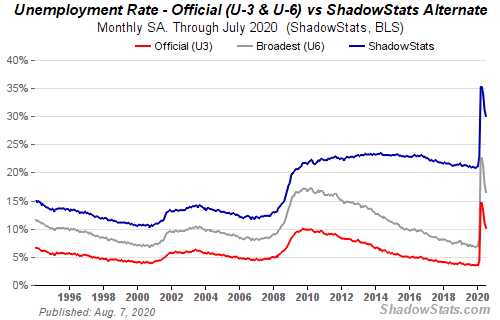
The red and gray lines are official statistics from the U.S. Bureau of Labor Statistics. The red line is the U3 unemployment rate, which primarily counts people who have recently applied for unemployment. This is the unemployment rate you'll hear in the mainstream and business media, because they want things to look as positive as possible. But it does not count everyone in the U.S. who's out of work, not even close.
The gray line is the BLS U6 unemployment number, down to about 16% to 17% right now. This is also an official U.S. government stat, and includes people who may have been forced to work part time, but would prefer to work full time.
The blue line is the shadow stats number, which adds in the people could work, but are discouraged, or have given up looking for a traditional job, for whatever reason. Before the year 1970 or so, there were very few people in this category, but the number has grown dramatically since, and no one knows exactly why.
Think tank brainiac, and author, Nicolas Eberstadt, wrote a book on this group of people in 2016, called Men Without Work: America's Invisible Crisis (not a paid link). Here's Eberstadt speaking on this topic, in 2017. The number of these men was about 7 million then, and has grown since, by all accounts. This number of long term unemployed people, not even looking for work, will most likely grow dramatically in the next couple of years.
Ebertadt says there is a growing number of women in this category, as well. These are able bodied people, of working age, who are not even looking for work anymore. Some of these people have felony records, and could not find good work after release from prison. Many seem to be former low skilled factory workers who couldn't find decent employment after their local factories shut down, 10-20-30 years ago. Many now get government checks, largely Social Security Disability. I met dozens of these people when I was living in North Carolina, in the low income areas there. All in all, very little is know about this huge group, and no one is really researching this issue in a serious way. In addition, the nation's opiate addiction epidemic, is very highly tied to this group of people.
Whatever the cause, they are part of the "working age American" group, and they are unemployed over the long term. So when you count the unemployed, if you want to be accurate, they should be counted. Hell, I'm officially in this group, though I do freelance artwork, and and I'm working on building a viable business out of that.
But the shadow stats number, now around 30% of the U.S. workforce, shows the most accurate total number of working age people who are not working, for whatever reasons. And that puts our current situation right up there with the numbers unemployed during the Great Depression of the 1930's. Long term solution ideas should take this large group of people into account.
Monday, August 10, 2020
The difference between mass psychology and economics in predicting markets
Tom Petty's "Don't Come Around Here" video seems the perfect lead into this post. In the economics and social world, we're down the rabbit hole, and everything is crazy and hard to predict right now. But that just makes it more interesting...
For over 30 years now, when I explained to average people why I read a lot of business books, real estate books, futurist books like those by Alvin Toffler, and studied the Forbes 400 magazine every year, I would tell people I'm an "economics geek." That shut people up, and they'd leave me alone. Even traditional geeks don't want to talk economics. I got interested in real estate in 1986, when I moved to Southern California, and the market was hot. I thought it might be a way to earn extra money as a young man. I started reading books on it, and kept following my interests, from there. I never went to college, I'm self-educated in this respect.
Being totally shy, scared of losing money, and a horrible salesman as a young guy, I wasn't able to raise money, or earn enough, to buy any houses then. In 1990, we went into a long recession, and I started getting more interested in the long term dynamics of real estate, business, and the financial markets. I began to watch the stock and precious metals markets daily, just seeing what happened, and trying to figure out why it happened. Rather than just "get rich," I wanted to grasp the long term dynamics of why different markets moved, and truly understand them. Then I could eventually invest in things when prices were low, and wait until the values rose, and make a profit. Without realizing it then, my natural way of thinking about business and investing was very similar to Warren Buffet and Charlie Munger's style of investing, at Berkshire Hathaway. Study, watch, wait for the prices to drop on things with inherent value, and then pounce and buy. Then wait for the markets to return, and prices to rise.
Basically, I wanted to truly understand markets, so I could predict the future of where they were heading. I predicted the 1993-94 interest rate spike that sent Orange County, California into bankruptcy. By late 1998, I sat the DotCom stock craze was getting ridiculous, and started talking about the eventual crash, which everyone then thought would never come. In 2000, it came. By late 2005, the California real estate market was going nuts, and I thought the inevitable crash was a year or so away. It took until 2008, but it came, big time. In all of those events, I was living on a low budget, and had no money to invest, but the dynamics of markets still fascinated me. I watched them from a distance, and kept reading, and kept learning.
When I saw the forces building for this current economic downturn, back in 2017, I was able to watch things much closer, and share my thoughts in my personal blog. I actually got threatened by a group, they were one step away from a lynch mob, because of my blogging, in North Carolina, in May of 2018. Despite the threat of being beaten by clubs, I kept blogging about the economy (and art and Old School BMX). Southern lynch mobs aren't used to people standing up to them, so the beatings didn't happen. Instead I managed to spend three days in jail in solitary, for heinous act buying donuts (after being told to leave a store, 2nd degree trespassing), and then get sentenced to $600 in fines, 50 hours of community service, and a 30 day suspended sentence. Pretty crazy for my first criminal offense, EVER, at age 51. These charges were dropped a year after I left North Carolina. The South is still The South. But I digress...
Anyhow, with years of watching markets, a few hundred books read, and a growing understanding of market dynamics, I had more time, and the internet and YouTube for research, heading into this recession (now actually a depression, technically). I decided to do my best to predict what I saw coming our way in the economy as this recession headed our way.
But this economic crisis is unlike any before in my life, or anyone's life. We headed into this downturn already living in Economic Never Never Land. Interest rates had been held incredibly low since the Great Recession. Major corporations, many former Industrial Age blue chips among them, loaded up on debt billions of dollars in debt, in the low interest rate environment. The Trump tax cuts, signed by the most corrupt president in modern history, were yet another windfall for major corporations, and high net worth people. Meanwhile, government bonds around the world went negative in many countries, and were ultra-low (and still are) in the U.S.. All the while, since late 2008, The Fed has been propping up Big Business and Wall Street, with the low interest rates and trillions of dollars in quantitative easing. The Fed is the "crack dealer" letting cheap money flow to the major economic players, who are now addicted to cheap money.
In addition, we have widespread smartphones, the internet, and a level of inter-personal and business connectivity never seen in human history. The newer, high tech businesses cluster together in a handful of major metros, like the San Francisco Bay Area, New York City, Boston, Seattle, L.A./SoCal, and Austin, Texas. A huge percentage of the U.S. economy is centered in those metros, while rural, small town, and small city America struggled to recover form the Great Recession. This helped create a huge economic polarity, which helped create a huge political polarity. In the lead up to this current economic collapse, we had crazy stuff happening that most business people and economists had never seen before. This wasn't going to be "just another recession." It was all new territory, and nobody knew what would happen.
In this chaotic mix, as stocks soared to all time highs on Fed created money in January, I predicted the unthinkable (here's that post), that the Dow would drop about 40%, and slide below 19,000 points. It was at about 28,800 and rising when I made that prediction, and other predictions, in my blog post. But I saw a change in momentum coming, soon. Three weeks later, a "black swan event" came, the Covid-19 pandemic hit U.S. shores, and businesses were forced to shut down for a couple of months. My "crazy" predictions for the Dow, the S&P 500, and the Russell 2,000, all came true within 8 weeks. I missed on my Nasdaq prediction, because that's where investors put their money as the market dropped.
Then shit went crazy, because the official financial world didn't see this crisis coming. Most of the "experts" didn't think there would even be a mild recession in 2020. As most people sheltered at home, the business news channels tried to make sense of what was going on. Being homeless, I struggled to simply find places to power up my laptop, and then find wifi spots I could use. You can't shlter at home, when you don't have a home. In yet another crazy aspect to the 2020 stock market crash, it was me, a homeless man, who accurately predicted the crash, and the depth of the crash. Nothing makes sense now.
As the reality of the pandemic, and the much needed, but financially catastrophic, business closures set in, everyone in the business media tried to figure out what happened. Then they try to find some happy ending to this mess. Everyone had opinions, and economists and public officials weighed in on this growing crisis. By late April, I was able to start consuming these ideas from others, and to try to find accurate information on what was actually happening.
I quickly began to figure out that, as I predicted the interest rate spike in 1993-94, the coming DotCom crash in 2000, and the real estate crash/Great Recession in 2008, I wasn't using hard number, nuts and bolts economics to make my preicitons. Most of what I was looking at was actually the mass psychology of investors, and the public at large. I did look at all kinds of economic trends, but I never got deep into the actual numbers.
So I've been learning more about actual economics, as I tried to figure out where we're going now. Economics is the study of financial data (technically, the study of "scarce resources"). But economists are notoriously not known for accurate predictions. They look at the data after events happen, and analyze what happened. I wanted to understand the dynamics, dig into the myriad of forces at play in the financial markets, and then be able to get a good idea of what's coming next.
Ideally, I will actually have resources to invest at some point, and make some money off of my thinking. My drive has always been to try and figure out what's coming next. And all that thinking led me to seeing a bunch of forces at work, social trends, social cycles, and things no one else pays attention to. But financial markets, even completely manipulated markets, like the stock markets right now, held up entirely by Fed money creation, are still a result of human psychology. Humans look at things, they make decisions and take actions, or don't take action. Lots of actions, driven by mass psychology, drive the markets. When the thinking in a large group of people changes, markets change soon after. And when you study the trends, and try to figure out what idea caused a market change, you begin to get an idea where things will head in the coming days, weeks, months, and years.
So I don't really tell people I'm an "economics geek" anymore. I'm really a futurist, fascinated by Big Picture social dynamics and economics. I try to accurately see the long term, mid term, and short term social trends going on, and get a grasp on the dynamics of these different trends, and how they affect and interact with each other. Then I look at the economics world, and lay the economic trends on top of my world view of social trends. That gives me some sense of where things are going. That's how I made the call that the Dow would drop below 19,000 in January, when most people were expecting Dow 30,000 and Dow 35,000 soon after. My thinking is a lot more like the late futurist Alvin Toffler, and his wife Heidi, than it's like Paul Krugman's, for example.
I came to my conclusion that we're heading into an actual great depression from underlying, long term, social trends, combined with economic trends. I'm working on putting the basic idea into a concise report. But there are so many tangents and offshoots to what's happening today, that I'm going to dive deeper into pieces of the big picture in this blog. This was not the blog post I sat down to write, but I hope it helps you readers get a better idea on where I'm coming from. Much more to come...
Saturday, August 1, 2020
The many waves of The Phoenix Great Depression
This is The Wedge, in Newport Beach, California, on BIG day. This video is about the best analogy I can think of for today's economic world. One big, gnarly, dangerous waves after another. The main plan is to not get destroyed by the economic waves, and then, try to ride one or two of them, if you can.
Last night I watched several CNBC interviews with top economists, about where the economy, and our financial world is headed. None of them really seem to have a good grasp on the Big Picture. Yes, I'm calling out Paul Krugman, Joseph Stiglitz, and several others. These are all very smart guys, and they have good insights on pieces of what's happening. But none seems able to predict the world that a handful of top investors see coming. For months, in some cases years now, top business guys and investors, like Ray Dalio, Robert Kiyosaki, Jim Rogers, and a few more, have been talking about a historic level economic downturn. OK, now we are definitely in it, and as of yesterday, this officially qualifies as an economic depression (see last blog post). So... what's going to happen now? And how long will this last? The top economists don't have good answers to these questions.
Here's my take on today's economic mess. First, as I wrote a few weeks ago, I've been watching several ultra long term trends, cycles, and shorter term trends, converge in recent years. I spelled out the basic idea in this blog post, and a few earlier ones. With so many major issues happening all at once in the economic/business world, and then the pandemic hitting hard on top of that, I saw several years of tough economic times heading our way. I've been blogging about some of these issues for three years now, like in this post, from June 2017.
There are so many different things that need to get worked out in this economic downturn, that I think it will feel much like the video of The Wedge, above. One big gnarly economic wave after another.
Here are the "waves" that have hit in the last 11 months:
-September 2019- The Repo Market seized up- The little known repo market, a sort of "pawn shop" for major banks and shadow banking businesses to get overnight loans, froze up. The Fed had to jump in to try and save it, by creating billions of dollars, and throwing that money into these markets, so banks and lenders needing short term loans could keep getting them. What started as a "week or two" of "adding liquidity to the markets" turned into $20 to $100 billion A DAY being shoved into the financial system, to keep it from collapsing. Most of America paid little attention to this issue.
-February/March2020- Stock Market collapse triggered by Covid-19 Pandemic/business shutdown- The financial world was teetering all last winter, but stocks surged, as The Fed pumped tens of billions daily into Wall Street and the banking system to shore up the Repo Markets. No bad news had much effect, a true sign of market euphoria. Then the pandemic hit U.S. shores, and national leadership didn't take it seriously. The completely inept, and late response to the pandemic has now led to the deaths of over 157,000 Americans. Though much needed for public safety, the mandatory business shutdown that has threatened millions of businesses, small, medium, and large. Several large businesses, and many smaller ones, have already gone bankrupt, and 25,000 stores are expected to close this year, far more than double the number that closed last year, the highest number ever. Because of this GDP dropped 32.9%, the biggest quarterly drop on record, EVER, in the second quarter of 2020. This has put the U. S. in completely unknown territory, economically.
April 2020 on- The first wave of business bankruptcies- Among the big names that have entered bankruptcy, are Pier 1 Imports, J.Crew, Lucky's grocery stores, Neiman Marcus, J.C. Penney's, GNC, Chuck E Cheese, Brooks Brothers, California Pizza Kitchen, and Hertz along with many other smaller businesses. Most of America's major corporations (except for the tech giants), were near insolvency in March and April, but the bailouts saved them... for now. There will be thousands more businesses going bankrupt as the other "waves" crash on our shore.
June 2020- Tens of millions of Americans are laid off, 40-50 million so far/unemployment claims spike to historic levels- While most of these layoffs were deemed "temporary" at first, it's obvious that a huge number of these will be permanent. The Fed and Congress has thrown 3 1/2 to 4 trillion dollars into the economy, most to major corporations, but a large amount into extra unemployment payments. This bought the country time. But the time is ending right now, as the $600 extra unemployment payments end.
Now, what other huge waves are headed our way? This is where the economists either are afraid to make forecasts, or are simply not sure what will happen soon. To be fair, economists, by nature, study what has already happened, not what might happen soon. This is where I come in. Here are several of the major "waves" I see headed our way.
-August-November 2020- The first big wave of evictions and foreclosures- (28 million people are on the verge of eviction according to this report). The moratoriums on evictions and foreclosures just ended, along with those extra unemployment checks. This inaction by Congress is putting the very survival of the United States of America at risk, holding back help for tens of millions of people who are in survival mode now, trying to figure out what to do.
-September- December 2020- Residential real estate market heads downward- This wave of evictions and foreclosures will begin to tip the residential real estate market downward, into a major collapse nationwide. The major metros, where real estate prices are highest, like New York City, San Francisco Bay area, L.A., and others, will probably get hit the hardest, at first. The trillions of dollars pumped into the financial markets buoyed up residential real estate these last few months, but that's ending soon. We'll see sales and prices begin to drop in the remaining months of 2020, and plummet in in 2021, in most areas. As I said, the major cities, with highest prices, will be hit first and hardest, but will also be the most likely to recover first, in 3 to 5 years or so, in my opinion. Why will it takes so long? Because there are a whole lot of other things that need to shake out, besides overly high real estate prices. Those things are subjects of other posts in this blog, and more coming in the future.
The wave of upscale people leaving cities and working from home, is much hyped right now, and is a factor. But once we get a Covid-19 vaccine, or quality treatment, I think major metro areas, particularly those with lots of high tech, will try to rebound. Those same cities will also have a lot more people homeless, in poverty, and struggling, at the same time. Dealing with these issues may delay a rebound. Smaller cities, towns, and rural areas will struggle much harder, and for much longer. We will see a bunch of mid-sized and smaller cities get hit the way Detroit got hit by the loss of manufacturing jobs, many years ago. This will be due to a lot of colleges and universities going bankrupt, and perhaps cities themselves. This, again, is an issue for other blog posts, coming soon.
-September-December 2020- Retail and commercial real estate market really begins to fall- Obviously, this has been happening for years, to some extent, we've all heard of the Retail Apocalypse, by now. But now we will have millions of square feet of office space open up, and ripple effects through mixed use, warehouse, and industrial properties. You've probably heard the term "Dead Mall," by now. For years, 400 or so of the nation's 1100+ shopping malls have been expected to close down eventually. A small number have, and some have been repurposed. But I think this amplified closing of an estimated 25,000 retails stores this year will start the malls to tumbling. We'll probably see 400 to 600 enclosed malls close down by 2025. Thousands of smaller shopping centers will have vacancy issues, as well. On the positive side, the malls expected to fair the best are the very high end malls, and the low end ones, where lots of lower income people shop. Generally speaking, those people are much less likely to buy a lot of items online, to be delivered. It's the mid-range malls (and cities) that are most likely to struggle.
Future economic "waves" coming at some point:
-Some kind of debt collapse in the SLABS (Student Loan Asset Backed Securities) market, the CLO's (Collateralized Loan Obligations), and the CMBS (Commercial Mortgage Backed Securities) markets- All three of these are similar to the Subprime mortgage securities that triggered the 2008 economic collapse.
-Crisis in auto loans, credit cards, and other consumer debt that's not being paid right now.
-Huge protests and social unrest caused by the millions of people who will likely drop into poverty in the coming months and years- Major healthcare and social programs will be needed to deal with this, much like the 1930's.
-The College Apocalypse- The collapse of the student loan system, along with the pandemic slowing down enrollments, AND the huge loss of revenue from college sports during the pandemic, will bankrupt colleges and universities. Dozens of small colleges have closed or merged, for other reasons, in recent years. But this financial crisis will cause major disruption to the whole college system, and I think we'll see a "College Apocalypse," something like the current Retail Apocalypse, starting in late 2021, and throughout the 2020's. This will cripple cities dependent on colleges and universities, as well. Higher education will have to re-invent itself for the 21st century, and the Information Age.
There will be others... but that's enough to bum you all out right now. Watch that video above again, and remember that metaphor.
Friday, July 24, 2020
28 Million Americans Face Eviction- CNBC article 7/24/2020
According to this CNBC article today, 28 million Americans face eviction. Uh... yeah... that's not good. Landlords are encouraged (by someone, apparently) to "be creative." I wonder if the banks and lenders the apartment owners owe money to are also encouraged to be creative.
This short article cites a recent survey of apartment owners, 60% of whom said their tenants can't make rent payments. All of their tenants? Or some of them? It doesn't say. In any case, here's another ginormous number in a bad category, possible evictions, giving us some sense of just how many people are seriously struggling to stay housed after the craziness of the past few months.
This short article cites a recent survey of apartment owners, 60% of whom said their tenants can't make rent payments. All of their tenants? Or some of them? It doesn't say. In any case, here's another ginormous number in a bad category, possible evictions, giving us some sense of just how many people are seriously struggling to stay housed after the craziness of the past few months.
Saturday, July 18, 2020
Why I believe we're in the beginning of a great depression, not a "quick" recession
This video was made in March 2020, when the stock market was hitting its first big bottom, and before most of the $3 TRILLION+ in bailouts really began. But this video gives a great view of how big and widespread this economic crisis is. This depth and breadth of this crisis is one major reason this will be a long downturn.
From my point of view, having followed and watched several long term social trends for many years, I see a long, rough, economic downturn for several other reasons. There is a convergence right now of several long term trends and major social changes, it's not just an "normal" economic recession that lasts 12-18 months.
Here is one of the big social upheavals I've been watching evolve for years, which almost no one even knows is going on. This is The Third Wave concept explained by the late futurist Alvin Toffler in his 1980 book, The Third Wave. The basic idea is very simple, the Industrial Age dominated by factories in every town is ending, and the Information Age is being built. At one level, we all know that. It's like, "Duh, of course!" To most people, this transition happened a long time ago. The factories shut down, a lot of small cities and towns struggled, and now we're in the Information Age.
But we're only PARTLY in the Information Age. Yes, nearly every person has a smart phone now, we don't share a phone with a cord attached to the kitchen phone like when I was a kid. We have streaming music, not CD's or vinyl records played on a record player. But our education system, K-12, is still an Industrial Age model. Our legal system, our criminal justice system, our political parties and system, they are all systems created in the Industrial Age. A lot of our old, major, industrial, "blue chip" businesses, are still largely working on underlying Industrial Age models. Our entire college/university system is still a model from the Industrial Age. Our local, state, and federal government bodies and agencies are still working on Industrial Age models. Yes, these all use new technologies, but the underlying systems and models they are based on, are still Industrial Age models.
Each of these businesses, governments, industries, or systems, will break down, and be disrupted, the same way Napster completely disrupted the music industry in 1999. This can either happen by people of the old model, intentionally re-inventing the old system, or completely new people inventing a new, Information Age system. Most of the time, it will be the second option. Thinking of the retail industry, Sears, the longtime major department store didn't see the potential of online shopping, and Jeff Bezos, who started Amazon, did. Bezos started a new model, and now, about 25 years later, Amazon is gigantic, and Sears is bankrupt. This basic scenario WILL happen to every part of society that it hasn't happened to yet. It's simply happening because new technologies making an entirely new business model or system possible.
This transition of everything, from the Industrial Age model, to the Information Age model, started slowly in about 1956, according to Alvin Toffler. The speed of this change has gradually increased, and now change is happening very rapidly. When it comes to 2020, this economic downturn is accelerating the level of this change. So we not only have a major economic recession, which started last September (Repo crisis), AND we have a major, 100 year pandemic, which has killed over 142,000 Americans, as of this morning. In addition to THAT craziness, those things are dramatically escalating the pace of change in the remaining Industrial Age businesses, governments at the local, state, and federal level, and systems of other kinds. In every system, business, or industry, these are HUGE, massive changes, and many of the old businesses wind up closing down, like chain stores in the Retail Apocalypse. This level of change, happening in so many different places at once, cannot possible happen in 12-18 months. Most... MOST of those major Industrial Age businesses were practically insolvent in March 2020. These major businesses, an Wall Street, have been propped up by somewhere around $3 trillion, just to keep them afloat, so they can try to recover. But this completely unprecedented level of bailouts WILL ALSO dramatically lengthen this recession/depression (it is officially a recession, for now).
So this is just one of several major social trends and cycles happening, and CONVERGING, at this point in time. The Third Wave aspect alone would turn a serious recession (6-18 months) into a depression (3 years or 10% GDP drop) or a great depression (5 year economic downturn).
So that is PART of the reason I'm calling this economic collapse The Phoenix Great Depression. It will be VERY deep. It will last several years, with different economic indices going up and down at times, and it includes a level of societal change, and speed of change, unheard of in human history. The "phoenix" part is the rebuilding of a new, viable society as we work through these many changes, at many levels, happening all at once.
Monday, July 13, 2020
Why I, personally, wouldn't touch the stock market for the next 2-3 years...
This is a CNBC report from March 9th, 2020, as stocks plummeted on Covid-19 shutdown fears, AND a whole slew of longer, underlying factors. The Dow was down about 1,700+ points at the time of this report. The Dow bottomed out at around 18,500, a couple weeks later.
Here's my 2020 predictions blog post, from my (now retired) personal blog, written on January 26,2020. The Dow was around 28,700 and still heading up, the Friday before I wrote this post. In that post, I predicted the Dow Jones Industrial Average would drop below 19,000 at some point in 2020. I also made predictions for the Nasdaq, the S&P 500, and the Russell 2,000. Of those four predictions, all but the Nasdaq prediction have actually come true. And we're just 6 1/2 months into 2020.
I'll go into more detail on how and why I made those predictions as this blog goes on. But there's a simple rule I learned in the late 90's, about commodity charts. It also generally applies to the stock markets. When a long bull market ends, the price drops approximately 50% of the entire bull market run. So if you take this last bull market in the Dow, check this chart, (click to "Max" timeline), and figure the points risen from February 2009 low, to the peak in February, 2020. Cut that number in half, and subtract it from the Dow's peak in February 2020, of 29,551. The Dow should drop to roughly17,800, at some point. You can do the same thing to the other index charts. I padded my predictions a bit, knowing that there may be one big drop, a likely rally for a while as the inevitable bailouts kick in, and very likely another, lower drop, at some point in the future. I was just trying to predict the initial big drop.
Once a long term bull market is over, in commodities or stocks, the markets are turbulent, and basically pretty much impossible to predict, for quite a while. This usually turns into a wide trading range for some time. In today's Dow, for example, I think we'll see a big, long trading range from roughly 23,000 to 28,000, up and down, for another 1-3 years. There SHOULD be 1 or 2 more big, DEEP drops, to Dow 17,800 or so. But that might not happen because The Fed is basically willing to completely devalue the dollar (eventually) to prop up all the major U.S. corporations and banks that were functionally insolvent in March, after the stock plunge.
In any case, the stock market is basically a gambler's market, for the next year, at least, and probably 2-3 years. Yes, there will be incredible bargains for long term investors, like Warren Buffet and Charlie Munger at Berkshire Hathaway. But you're not Warren or Charlie.
In addition to that, with so many other factors happening in the economy, like real estate collapse that's coming, the continued retail apocalypse, precious metals rising, and more bankruptcy auctions coming than ever in human history, I think there will be thousands of amazing opportunities for small and mid-level investors, that will be much more lucrative than stocks over the next 1-3 years. So that's why I wouldn't touch the stock markets now, if I was in a position to invest a serious amount of money.
Friday, July 10, 2020
The relationship between this "recession" and Toffler's Third Wave
This is actually a good news/PR piece about online shopping versus brick and mortar stores, from last year. Physical stores aren't all going to disappear, as online shopping keeps growing. But a huge percentage of traditional brick and mortar stores will close down. This is The Toffler's Third Wave concept in action, in the retail sector.
This post is a tiny piece of a real big network of ideas, and that's what this blog is for, to flesh out little bits and pieces of my concept of The Phoenix Great Depression, as it happens, in real time. I put "recession" in quotation marks in the title, because I believe this current recession will ultimately be a true depression, and a "functional" great depression. I think we will very likely see a 10% drop in GDP growth for Q2 2020, thanks, of course, to the Covid-19 Shutdown. A 10% drop in GDP makes this recession a "depression," like it or not. But those numbers won't be out until July 30-31, about three weeks form now. GDP will bounce back to some extent, but I believe we're basically in a 5 to 7 year economic mess as a country (and world). That's a "functional" great depression, even if it is not a textbook one.
Now, on to the point of this post. In 1980, futurist Alvin Toffler published a book called The Third Wave. The basic idea was that the onslaught of new technologies emerging then, like the weird concept of everyone owning a personal computer and other gadgets, were going to fundamentally change how society functions at a deep level. This had only twice before, in 10,000 years. Roughly 10,000 years ago, the agricultural revolution began, most likely in Turkey, and humans slowly changed from hunter/gatherers to farming based people. That changed how nearly every human on Earth lived, over a couple of thousand years. The agricultural revolution was the First Wave, as Alvin, and wife Heidi, saw it. People went from wandering tribal groups to farming communities settled permanently in one area. That was a huge shift.
About 350 years ago, the Second Wave began. That was the shift from agricultural-based society to an industrial-based society. That wave happened quicker, over 200 years or so, as most people stopped being farmers, and moved to cities and got jobs in factories. Again, another fundamental shift in how people lived on a day to day basis, based on new technology, like the steam engine, mechanical inventions, and later, electricity. The Greatest Generation, The Baby Boomers, and my peeps, Generation X, were all born into the late stage of the Industrial Age. That's our "normal."
But the Third Wave, as the Tofflers saw it, was emerging, with computers, new medical technologies, new communications technologies, and advanced robotics, among other ideas, gaining steam and turning into functional products. The Third Wave is the shift from an industrial-based society to an information-based society. It's a long, sticky transition from the Industrial Age to the Informaiton Age. Alvin and Heidi Toffler saw this as fundamentally changing how human beings would live and interact. Except this huge shift was happening much faster, basically in a single human lifetime. They put the beginning of the Information (or Digital) Age at 1956. That was the first year that "white collar" office workers outnumbered "blue collar" factory workers in the United States. So in 1980, Alvin's book, The Third Wave came out, and it had a great influence on many influential people.
But then other books, other notions, other ideas came along, and the Toffler's Third Wave idea faded from most people's consciousness. I began reading Toffler's work in the 1990's, and the Third Wave idea stuck in my head. As I watched society begin to change more and more rapidly, and see things like Napster disrupt the entire music industry with a click of a mouse, I began to think the Third Wave was still playing out. As the internet rose in popularity and widespread use, and as car phones turned to cell phones, and now into smartphones with photo, video, text, and wifi capabilities, The Toffler Thirs Wave concept, and other ideas, explained a lot of what I saw happening.
So what is The Retail Apocalypse, which the news story above is about? The Retail Apocalypse is the breakdown of the Industrial Age goods distribution system, and the building of an Information Age goods distribution system. It's as simple as that. Officially, 9,300 retail stores closed in 2019 alone, and about 20,000 in 2017-2019 combined. Coresight now estimates that about 25,000 retail stores will close in 2020 alone, due largely to the pandemic-induced shutdowns. Not ALL retail stores will close down, as the news clip above explains. But tens of thousands of them will. Amazon DID NOT cause this. Jeff Bezos at Amazon, and other visionaries like him, at eBay, Shopify, Wish.com, Etsy, and other online retail sites and platforms, saw the potential future, and built something for the Information Age retail world. Sears, J.C. Penney's, and many others, DIDNOT see the future potential of online shopping, largely because they were the 800 pound gorillas of retail at the time. They laughed, how could a few tech geeks with a website threaten their behemoths? And then the paradigm began to shift. Remember, Blockbuster video had the chance to buy Netflix for $20 million, once. When's the last time you went to a Blockbuster store to get a movie on VHS?
The Phoenix Great Depression is not about retail sales in particular. I believe EVERY industry and human institution, that hasn't had a "Napster-level," Big "D" Disruption, will see one. Period. No one gets "spared." The Retail Apocalypse is Disruption in the retail world. The populist movements which brought Trump and Berrnie Sanders into the limelight, are Disruption happening in the political parties. The next phase of real estate Disruption is happening. Look at commercial real estate before the pandemic. Now try to imagine it after Covid-19, if you can.
We're about to see the College Apocalypse begin in a big way, it has already put dozens of small schools out of business. EVERYTHING, every business model, every institution, every human system still left from the Industrial Age, from the criminal justice world to manufacturing furniture, to how non-profits work, to how hospitals run, to basic things like the toilet industry, they will all see massive Disruption. The old, Industrial Age way of doing things will continue to break down, and a new, Information Age version will be built, probably by a different group of people.
This isn't something that can be stopped, most of us (me included, I used to be a serious Luddite) will not like this messy transition. But it's going to happen anyway. Period. You can surf the wave, or get pummeled by it, to use a California metaphor. It will happen because of all the new technologies in our world, and those still being developed, make an entire new way of life possible. Visionaries in many areas will build new models for different aspects of society, business, non-profit, and social.
Now... what does this current recession (eventually a depression), have to do with this Third Wave transition? As I was blogging about aspects of these ideas over the last three years, and saw a pretty serious recession coming soon, I realized that the speed of change was constantly increasing, and that this coming recession (the one we're in now) would amplify the speed of change. In effect, the converging of the Third Wave's Disruption with a major recession, was going to shift the speed of change into 5th gear. The parts of our society that were already changing, like retail, would change even faster. An the parts of society that had not yet changed (like K-12 and higher education, for example), would be forced into rapid change, BECAUSE OF the serious economic downturn. We WILL see a visible College Apocalypse appear in 2021, as well as other major changes. This convergence of a serious recession/depression would force parts of society to change very rapidly. That's what I saw as coming at us, as of last year.
And then, in February and March, the Covid-19 pandemic hit American shores. Unfortunately, with the pandemic came a completely horrible response to it from the White House and the national leadership here in America. So the pandemic has become much worse that it had to be. This pandemic has shifted the rate of change from 5th gear to light speed. I imagine most of you know the scene in the original Star Wars movie, where Han solo first shifts the Millenium Falcon into light speed. That's what just happened to the rate of change of every business model in the U.S., and the advanced world. There will be changes in business models, but also in social systems and models. Black Lives Matter is just the beginning on the social change front. There will be much more along those lines, from many different groups of people.
Simply put, there is no way we can make all the changes needed, in an 18 month, "normal" recession. This will take years. If that isn't enough, we've all seen the unprecedented response by The Fed and other central banks. What did they do? They created enormous sums of money and threw it at Wall Street and corporate America. By "adding liquidity," to the tune of several trillion dollars, they are literally propping up the largest Industrial Age businesses, keeping them on life support, hoping this "recession" will end quick. It won't. Because it's not just a recession, there are several long term trends and transitions, like the Toffler's Third Wave, playing out as well. Many of the major corporations being bailed out right now won't live through this decade. And propping them up will literally make the "recession" last much longer than it really needs to. The bailouts will be part of what makes a needed depression turn into a functional great depression. Propping up "zombie companies" delays Schumpeter's "creative destruction," which is necessary. I'm not saying these companies components will disappear, but they will likely be part of different, Information Age companies, a decade from now. Maybe an Elon Musk-type person will be running GE's jet engine business, or something like that. Capitalism lets inferior businesses fail, it's a necessary part of the process, and we've said "goodbye" to capitalism,at this point.
So in very simple terms, this current economic downturn will speed up the rate of change, in many industries and institutions. The pandemic will dramatically increase the speed of that speeded up change. This is going to hurt. But the upside is the "phoenix" part of The Phoenix Great Depression. If you understand what's really happening, and see this Big Picture myself, and some others are looking at, then you can pick a part of the world and begin building a new model, part of the Information Age that will live on for decades to come. Are you up for that?
Monday, July 6, 2020
Nouriel Roubini on the "recovery," and the issues we're facing in the 2020's
A professor at NYU, and one of the most hardcore realists among economists, Nouriel Roubini gives a great take on the myriad of issues we're facing in this new decade, and what the recovery may look like. He sees what may be a "Greater Depression" in the mid-20's, and he explains the ten drivers that could lead to it.
Saturday, June 27, 2020
106 MILLION loan payments skipped recently
In this Forbes column, we hear that 106 million different loans have not been paid on time, in the last two months. Not $106 million dollars, but different loans. The information comes from Trans Union, one of the big credit rating agencies.
For the last 12 years, spurred by The Fed's artificially low interest rates, most of the U.S. (and much of the world's) economy has been fueled by debt. In everyday terms, American businesses, the U.S. government, and most consumers, have been living on their "credit cards" for more than a decade. Now they (we) can't make their payments in many, many cases. A huge chunk of those loans are not being paid back, due to the shaky financial system and the Covid-19 sparked downturn and business shutdown. So what happens to a world propped up by debt when the debt stops getting paid back? A collapse of some sort is inevitable, unfortunately. Tick. Tick. Tick...
For the last 12 years, spurred by The Fed's artificially low interest rates, most of the U.S. (and much of the world's) economy has been fueled by debt. In everyday terms, American businesses, the U.S. government, and most consumers, have been living on their "credit cards" for more than a decade. Now they (we) can't make their payments in many, many cases. A huge chunk of those loans are not being paid back, due to the shaky financial system and the Covid-19 sparked downturn and business shutdown. So what happens to a world propped up by debt when the debt stops getting paid back? A collapse of some sort is inevitable, unfortunately. Tick. Tick. Tick...
Subscribe to:
Posts (Atom)
-
Yes, it seems totally counter-intuitive, but a lot of businesses, including several major ones, got started in recessions and depressions. ...
-
Here's one aspect of the economy I wasn't familiar with until seeing Robert Kiyosaki interview Jim a couple of month s ago. In this...
-
This pretty much sums up where I see the economy going in the next 1 to 5 years. We are now one year into what I call The Phoenix Great Dep...


