Showing posts with label #recession. Show all posts
Showing posts with label #recession. Show all posts
Friday, October 9, 2020
Businesses that were started in recessions
Yes, it seems totally counter-intuitive, but a lot of businesses, including several major ones, got started in recessions and depressions. Chrystie at AppSumo talks about a few of them, mostly recent tech companies.

Thursday, September 24, 2020
We are now 1 year into the economic crisis: The Phoenix Great Depression
Here's a Bloomberg news report from September 17, 2019 talking about some banking thing called the Repo Market. I'm a geek on this stuff, and I didn't know what the Repo Market really was. Here's a short video explaining the Repo Market. But this seizing up of the little known (to average people) Repo Market was the real start of the depression (yes, it's technically a depression now) we're in. Most people paid little attention. But the Federal Reserve (of New York) had to rush in and create $50 billion+ in one day, to keep the banking system from crashing. Then it had to create more money shortly after, and it became an ongoing bailout, day after day, week after week, flying under most people's radar. Then, the virus hit our shores, which became the bad news the stock market couldn't ignore, and then came February/March stock market crash, followed by the business shutdown, which is when everyone realized there were serious issues in the U.S. (and world, economy).
"The Phoenix Great Depression" is the name I gave to this economic crisis, which I've been blogging about for three years. I have been watching some ultra-long term trends and cycles play out, and could tell in late 2017-2018, that "the next recession" was really going to be a serious one, and possibly a long, full blown, depression or great depression. I coined the term, "The Phoenix Great Recession" in my old, personal blog, (Steve Emig: The White Bear) in October 2019. Nobody was ready to hear the word "depression" yet. Most people still aren't.
Basically, The Repo Market functions kind of like a pawn shop for banks. A bank needs a few million bucks to make its quotas for the night's books. So it sells something of value to another bank, usually U.S. treasury bills/bonds/notes. The borrowing bank gets the money to cover its short term needs, and it buys back the T-bills (or whatever) the next day, or maybe two days later, and pays the lending bank interest. "Repo" stands for re-purchase, not repossession.
What happened last September is that some banks (probably part of the "shadow banking system"), looked so sketchy, that nobody wanted to lend to them, so they charged much higher interest than normal. That seized up this overnight market, and freaked out Big Banking insiders, and The Fed came to the rescue. The Repo Market played a big role in keeping Lehman Brothers alive back in 2008, before if finally became insolvent and closed up, the turning point in the 2007-2009 Great Recession. So this time around, The Fed started bailing the system out, and it's been bailing the system out ever since. The money they've created out of nowhere, and "injected" into the banking system is the money that's driven the rise in stocks and real estate since last year. The markets aren't rising because of solid, fundamental reasons, there's just a ton of money for banks to gamble with right now. The Fed can't keep doing what they're doing forever, without completely devaluing the dollar until it loses all value. Right now the whole system is being propped up, and nobody knows a good way out of this mess. So that's where we are a year into this economic crisis.
Sunday, August 30, 2020
The Bubbles still left to pop- With Robert Kiyosaki, Harvey Dent, Stan Harley
Robert Kiyosaki, best known as author of Rich Dad, Poor Dad, does a regular (weekly, I think) radio show/podcast about different aspects of money, investing, and the economy. He gets some really good, really smart people on this show. This is a scary, but very good show, with Harry Dent and Stan Harley talking about the current bubbles in stocks and real estate. These guys are seeing historically economic BIG bubbles that are getting close to popping.
"The greater the bubble, the greater the burst."
- Harry Dent, in the interview above
It's late August 2020, as I'm writing this. In my opinion, we are now 11 months into what I'm calling The Phoenix Great Depression. That's my own term, but I see this as the beginning of a 5 to 7 year (minimum) economic downturn. There are a couple of long term trends and cycles, and several shorter term ones, that have brought me to my conclusion. This current crisis started with the seizing up of the Repo Market, in the banking industry, in September of 2019. The Federal Reserve (aka The Fed), had to begin injecting billions of dollars, weekly, then daily, into the financial system, to simply keep the banking system from collapsing. That slipped under most people's radar.
Then, the Covid-19 coronavirus (aka Sars Cov-2), hit U.S. shores, which was the "black swan" event that tipped the U.S. stock markets into collapse. As we all know, the shutdowns have led to all kinds of problems, millions have lost their jobs, mandatory business shutdowns, and tens of millions of people now struggling to simply pay rent. I saw a huge economic collapse coming, and have been blogging about it for three years.
The two guys in the interview above, Harry Dent and Stan Harley, have come so very similar conclusions, using completely different cycles and models. One of the things that is amazing to me about our current economic mess, is that several, really smart economic thinkers, investors, and forecasters, have come to the same conclusion about a huge peak and then crash, right now, in this 2019-2022 period. But all of these thinkers (myself included), have come to very similar conclusions, from very different forecasting directions. We're all looking at different data sets, different cycles and theories, but coming to the conclusion that this is going to be a historically huge economic downturn. You can easily discredit me, I'm a bum, but it's hard to deny the thinking of Robert, Harry, and Stan above, as well as Ray Dalio, Jim Rogers, and several others. Even internet marketing expert and entrepreneur Gary Vaynerchuk has been waiting for this collapse, and has talked about it.
That said, this interview above is one of the most intelligent looks at what's happening in the economy these days. If you're interested in running a business in the next few years, and/or investing, watch/listen to this interview above. It's a lot to take in, so maybe watch it a couple times, or until it begins to make sense.
Yesterday, I predicted that the Nasdaq would drop before 8,000, before the November 3rd U.S. presidential election, and I predicted really low numbers for the Dow and the S&P 500 as well. All conventional wisdom, all common sense right now, says it's completely INSANE to think that The Fed would let the stock markets drop before the election. The Fed's main job right now (in many people's eyes), is to get Donald Trump re-elected. I know my prediction seems completely nuts. My January 26th prediction that the Dow would drop below 19,000, was also completely nuts, according to conventional wisdom then. Yet, it happened.
My reasoning for yesterday's crazy prediction is that we are now sitting on several financial bubbles, any of which could collapse at any time, triggering the collapse of the rest. When one really begins to go, it will start to topple the others. That toppling will lead to a world financial system wide crisis, and that will bring down the currently over-inflated stock markets. Here's a quick list of businesses and markets that will hit crisis point, could reach a collapse point, and trigger a mess that would bring down stocks, and everything else.
-SLABS (Student Loan Asset Backed Securities) market- There's no good data, but probably 50%-70% of student loans are being paid right now. When this market goes, everything topples.
-CMBS (Commercial Mortgage Backed Securities) market- Commercial real estate? Yeah, not good these days. When this market collapses, like subprime MBS and CDO's in 2008, other things start collapsing as well.
-CLO (Collateralized Loan Obligations) market- CDO-type investments made from business loans. Business loans in 2020? Yeah, not a good bet after the Covid-19 shutdowns. Smaller than the two above, but if this collapses, it will start the other two above toppling.
-Deutsche Bank- It's been struggling for many years. If it goes bankrupt, it will send shock waves through the worldwide financial system. That will start other houses of cards falling.
-A major banking/corporate bankruptcy in the U.S.- Boeing is known to be struggling. GE is known to be struggling. Capital One is known to be struggling. Many other major corporations are loaded with debt and struggling under the crazy conditions the pandemic and 2020 has thrown at us. If one MAJOR corporation goes bankrupt, especially one tied to banking, it will send shock waves through the financial system, and these other things begin to topple.
-Serious evidence of a likely Joe Biden presidential win- If the polls turn dramatically in Biden's favor, Wall Street will react, believing much less money will be thrown at them in the future, sending markets down. The stock markets are completely detached from the real world economy, and from reality, at this point. We're at a Tulip Mania level, and there WILL be a huge correction sometime. Personally, I think a Democrat presidential victory is likely, and is basically our only hope of survival as a nation and democracy. Just for the record, I'm an independent, and not a fan of Joe Biden. But we need a semi-functional government, and less money thrown at Wall Street, and more at the American Public, to get through the current, and the coming crises. Short term, the markets will throw a temper tantrum, and drop significantly, giving us the much needed correction. In the long term, this will help the economy, bringing all types of assets down to real world values. This alone could drop the stock markets before the election. My personal thinking right now is that one of the things above, not a big Biden lead in the polls, will be the cause of the drop, but huge poll numbers for Biden COULD send markets down pre-election.
-There are many other things that could send all these houses of cards tumbling before the election. Bad Q3 earnings for major businesses, major commercial real estate numbers dropping significantly, national residential real estate numbers dropping significantly, a large virus surge in a major city, causing another short term shutdown. Lots of things COULD happen, any one of which would send all these houses of cards toppling down. My bet is that one of these will happen before the election, and will cause massive chaos in other areas, which will ultimately bring down the hyper-inflated stock prices. There are just too many possible triggers of potential collapse for The Fed to continue to prop everything up for two more months. This is very similar to my thinking in January.
I know this is a very controversial call, we'll see how things play out.
Tuesday, August 18, 2020
The REAL U.S. unemployment rate is somewhere between 10% and 30%
The Money GPS puts out daily videos with a whole bunch of firsthand chart, stats, and articles, about the economy and current trends. These can be depressing, but it's a lot of solid economic data from firsthand sources, and he includes the links so you can dig deeper into any issue, if you like. For these reasons, I watch his videos every day.
This Money GPS video from August 16th, 2020, shows a Shadow Stats chart about the different unemployment rates available today. He shows the chart at 8:08, and talks about it. Here's the chart from shadowstats.com.
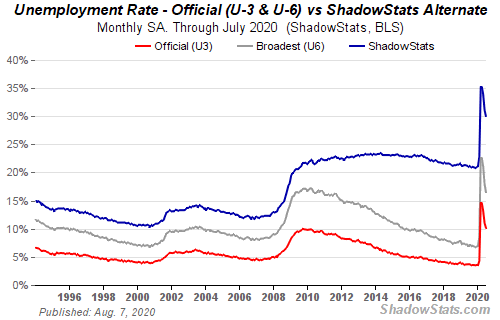
The red and gray lines are official statistics from the U.S. Bureau of Labor Statistics. The red line is the U3 unemployment rate, which primarily counts people who have recently applied for unemployment. This is the unemployment rate you'll hear in the mainstream and business media, because they want things to look as positive as possible. But it does not count everyone in the U.S. who's out of work, not even close.
The gray line is the BLS U6 unemployment number, down to about 16% to 17% right now. This is also an official U.S. government stat, and includes people who may have been forced to work part time, but would prefer to work full time.
The blue line is the shadow stats number, which adds in the people could work, but are discouraged, or have given up looking for a traditional job, for whatever reason. Before the year 1970 or so, there were very few people in this category, but the number has grown dramatically since, and no one knows exactly why.
Think tank brainiac, and author, Nicolas Eberstadt, wrote a book on this group of people in 2016, called Men Without Work: America's Invisible Crisis (not a paid link). Here's Eberstadt speaking on this topic, in 2017. The number of these men was about 7 million then, and has grown since, by all accounts. This number of long term unemployed people, not even looking for work, will most likely grow dramatically in the next couple of years.
Ebertadt says there is a growing number of women in this category, as well. These are able bodied people, of working age, who are not even looking for work anymore. Some of these people have felony records, and could not find good work after release from prison. Many seem to be former low skilled factory workers who couldn't find decent employment after their local factories shut down, 10-20-30 years ago. Many now get government checks, largely Social Security Disability. I met dozens of these people when I was living in North Carolina, in the low income areas there. All in all, very little is know about this huge group, and no one is really researching this issue in a serious way. In addition, the nation's opiate addiction epidemic, is very highly tied to this group of people.
Whatever the cause, they are part of the "working age American" group, and they are unemployed over the long term. So when you count the unemployed, if you want to be accurate, they should be counted. Hell, I'm officially in this group, though I do freelance artwork, and and I'm working on building a viable business out of that.
But the shadow stats number, now around 30% of the U.S. workforce, shows the most accurate total number of working age people who are not working, for whatever reasons. And that puts our current situation right up there with the numbers unemployed during the Great Depression of the 1930's. Long term solution ideas should take this large group of people into account.
Thursday, July 30, 2020
This is OFFICIALLY a Depression now: 2020 Q2 GDP drops a record 32.9%
The U.S. GDP dropped 32.9% in the second quarter of 2020, with numbers out this morning. There were already many issues in the economy, like the Repo Market seize up in September 2019, before the second quarter came around. But it was the Covid-19/coronavirus pandemic shutdown that was the "black swan event" that really sent things downhill. For those not up on economics, the GDP is the Gross Domestic Product, basically all goods and services bought in the U.S. the second quarter, April, May, and June, of 2020. The next biggest drop was about 28%... back in 1921. Even in The Great Depression of the 1930's, no single quarter's economy dropped this much.
I love how the CNBC hosts say, "It wasn't as bad as the 34.7% drop expected." That's a lot like saying, "Today I expected to catch Covid-19, have a car accident, get mauled by a grizzly bear, get hit by an asteroid, and be in a plane crash. And I ONLY got in a plane crash, caught Covid-19, and got attacked by a small bear, so it wasn't as bad as expected." It's that ridiculous.
If you look at the "definitions" section for an economic depression on this Wikipedia page, you'll see one of two things define an economic "depression." Either there's a recession that lasts for 2 years or more (Investopedia and the traditional definition is 3 years), OR there's a 10% decline in GDP. Today's numbers tripled that level. Again, we had a 32.9% drop in GDP. So, like it or not, this economic downturn is OFFICIALLY a depression. When this time is written about in history, it will be called a depression, or a maybe great depression, if it lasts more than five years.
I'll be fair, this depression would have happened if anyone was president. Donald Trump didn't cause the depression. But the Trump administration did do things that made it worse. The completely inept reaction to the pandemic when it first hit U.S. shores has not only killed thousands more Americans than it would have, but it is making the economic situation far worse, in the long term. The Trump tax cuts were a windfall for the uber-rich and major corporations, and that helped prop up a weak economy for many more months. Because the recession that should have started in 2017 or 2018 was held off, markets went much higher, and financial bubbles got much bigger. Because of that, the economy had (and still has) much farther to drop.
Also, when Fed chair Jerome Powell started raising interest rates in late 2016, and into 2017, pressure was put on him to reverse course, because higher interest rates were freaking out the stock market. At that time, Powell was trying to get interest rates from a historical low position, to a more "normal" level, which would give The Fed more ways to deal with the next recession. But he suddenly reversed course, apparently under heavy pressure from the White House and others, and eventually lowered rates, to help prop up stocks and other financial markets. This also propped up a weak economy that desperately needed a serious correction, a recession. So when a crash did finally come, it was a much worse one than it would have been if it hit in 2017 or 2018.
So why does it make a difference if we're in a recession or a depression? A depression is simply more intense, and will likely last quite a bit longer. Simply acknowledging that we're in a "depression," should make people think more intensely about how to survive and work out of it. It should also get us to look at this as a longer term, serious issue, not just something that will work itself out in six months. The downside is that a lot of people freak out when they hear "depression." And people are freaked out already.
My personal opinion is that it's better to state it clearly, accept that this is a major deal, and then get to work looking for solutions in all the issues facing us, like 28 million people on the verge of eviction. We don't need millions more people on the streets or living in cars suddenly. But our jacked up political system likes to spin things, even serious things, hoping the problems will go away if they can convince enough people it's not that bad. Politicians can call this whatever they want, but if you get an eviction notice, shit gets serious... real quick.
This is a serious economic crisis. It's not being handled well, though the trillions of dollars The Fed has created have helped big business, wealthy people, and many recently unemployed people... for a while. But this help comes at a huge cost later on, in the form of heavy inflation, possibly full blown hyper-inflation. We need to put on our Big Boy and Big Girl pants and work out some really big solutions soon to some really big problems, and get a handle on keeping struggling people housed, finding new jobs, saving small businesses, and everything else we're dealing with.
Here's my recent blog post explaining why I started calling this economic downturn The Phoenix Great Depression several months ago. There are a lot of really long term trends and cycles converging, making this much more than a typical recession.
Friday, July 24, 2020
CNBC asks if we're in a great depression, citing huge big city unemployment numbers 7/21/20
In this CNBC article from last Tuesday, they actually printed the words "Great Depression," on CNBC. Believe me, that's a big moment when they admit that's a possibility. The reason the article asks the question is because of the huge unemployment numbers in major cities right now. Here are the June unemployment numbers from the article:
Real unemployment stats are likely higher, only people actively seeking employment, and signing up for unemployment get counted. There were at least 7 million working age men not officially working and not looking for work before all of this started (Eberstadt- "Men Without Work"), and unemployment doesn't include a lot of independent workers, gig workers, small business people not working because or mandatory closures, people with reduced hours, or people who've accepted pay cuts. In all likelihood, we're probably near or over the 25% unemployment threshold of The Great Depression of the 1930's, if everyone could actually be tallied up.
The article says there's no real definition of "great depression." According to economist Ravi Batra's books, which I read in 1989-1990, there is, or at least was, a definition. A recession is an economic contraction (total economy shrinks) for two consecutive quarters, meaning 6 months. A depression is an economic contraction for 3 years, OR a 10% drop in GDP. We may see a 10%+ drop in GDP in the official Q2 numbers coming out next week, July 30-31. A great depression, by the traditional definition is an economic contraction for 5 years or more.
My personal opinion, and the reason I've been writing on this subject for about 3 years now, is because I think we're at the start of a true depression, and it will feel like a full blown great depression of 3-5, and likely 7 years, of tough economic times. Since the traditional definition has been abandoned, I don't know what this economic downturn will be called, but it will be a long tough ride for most Americans. BUT, recessions and depressions are also a great time of innovation, new business ideas, new industries emerging, and a lot of opportunities hidden in the economic mess.
New York City- 20.4% unemployment
Los Angeles- 19.5%
Chicago- 16.1%,
Detroit (it went up)- 17.7%.
Real unemployment stats are likely higher, only people actively seeking employment, and signing up for unemployment get counted. There were at least 7 million working age men not officially working and not looking for work before all of this started (Eberstadt- "Men Without Work"), and unemployment doesn't include a lot of independent workers, gig workers, small business people not working because or mandatory closures, people with reduced hours, or people who've accepted pay cuts. In all likelihood, we're probably near or over the 25% unemployment threshold of The Great Depression of the 1930's, if everyone could actually be tallied up.
The article says there's no real definition of "great depression." According to economist Ravi Batra's books, which I read in 1989-1990, there is, or at least was, a definition. A recession is an economic contraction (total economy shrinks) for two consecutive quarters, meaning 6 months. A depression is an economic contraction for 3 years, OR a 10% drop in GDP. We may see a 10%+ drop in GDP in the official Q2 numbers coming out next week, July 30-31. A great depression, by the traditional definition is an economic contraction for 5 years or more.
My personal opinion, and the reason I've been writing on this subject for about 3 years now, is because I think we're at the start of a true depression, and it will feel like a full blown great depression of 3-5, and likely 7 years, of tough economic times. Since the traditional definition has been abandoned, I don't know what this economic downturn will be called, but it will be a long tough ride for most Americans. BUT, recessions and depressions are also a great time of innovation, new business ideas, new industries emerging, and a lot of opportunities hidden in the economic mess.
28 Million Americans Face Eviction- CNBC article 7/24/2020
According to this CNBC article today, 28 million Americans face eviction. Uh... yeah... that's not good. Landlords are encouraged (by someone, apparently) to "be creative." I wonder if the banks and lenders the apartment owners owe money to are also encouraged to be creative.
This short article cites a recent survey of apartment owners, 60% of whom said their tenants can't make rent payments. All of their tenants? Or some of them? It doesn't say. In any case, here's another ginormous number in a bad category, possible evictions, giving us some sense of just how many people are seriously struggling to stay housed after the craziness of the past few months.
This short article cites a recent survey of apartment owners, 60% of whom said their tenants can't make rent payments. All of their tenants? Or some of them? It doesn't say. In any case, here's another ginormous number in a bad category, possible evictions, giving us some sense of just how many people are seriously struggling to stay housed after the craziness of the past few months.
Saturday, July 18, 2020
Why I believe we're in the beginning of a great depression, not a "quick" recession
This video was made in March 2020, when the stock market was hitting its first big bottom, and before most of the $3 TRILLION+ in bailouts really began. But this video gives a great view of how big and widespread this economic crisis is. This depth and breadth of this crisis is one major reason this will be a long downturn.
From my point of view, having followed and watched several long term social trends for many years, I see a long, rough, economic downturn for several other reasons. There is a convergence right now of several long term trends and major social changes, it's not just an "normal" economic recession that lasts 12-18 months.
Here is one of the big social upheavals I've been watching evolve for years, which almost no one even knows is going on. This is The Third Wave concept explained by the late futurist Alvin Toffler in his 1980 book, The Third Wave. The basic idea is very simple, the Industrial Age dominated by factories in every town is ending, and the Information Age is being built. At one level, we all know that. It's like, "Duh, of course!" To most people, this transition happened a long time ago. The factories shut down, a lot of small cities and towns struggled, and now we're in the Information Age.
But we're only PARTLY in the Information Age. Yes, nearly every person has a smart phone now, we don't share a phone with a cord attached to the kitchen phone like when I was a kid. We have streaming music, not CD's or vinyl records played on a record player. But our education system, K-12, is still an Industrial Age model. Our legal system, our criminal justice system, our political parties and system, they are all systems created in the Industrial Age. A lot of our old, major, industrial, "blue chip" businesses, are still largely working on underlying Industrial Age models. Our entire college/university system is still a model from the Industrial Age. Our local, state, and federal government bodies and agencies are still working on Industrial Age models. Yes, these all use new technologies, but the underlying systems and models they are based on, are still Industrial Age models.
Each of these businesses, governments, industries, or systems, will break down, and be disrupted, the same way Napster completely disrupted the music industry in 1999. This can either happen by people of the old model, intentionally re-inventing the old system, or completely new people inventing a new, Information Age system. Most of the time, it will be the second option. Thinking of the retail industry, Sears, the longtime major department store didn't see the potential of online shopping, and Jeff Bezos, who started Amazon, did. Bezos started a new model, and now, about 25 years later, Amazon is gigantic, and Sears is bankrupt. This basic scenario WILL happen to every part of society that it hasn't happened to yet. It's simply happening because new technologies making an entirely new business model or system possible.
This transition of everything, from the Industrial Age model, to the Information Age model, started slowly in about 1956, according to Alvin Toffler. The speed of this change has gradually increased, and now change is happening very rapidly. When it comes to 2020, this economic downturn is accelerating the level of this change. So we not only have a major economic recession, which started last September (Repo crisis), AND we have a major, 100 year pandemic, which has killed over 142,000 Americans, as of this morning. In addition to THAT craziness, those things are dramatically escalating the pace of change in the remaining Industrial Age businesses, governments at the local, state, and federal level, and systems of other kinds. In every system, business, or industry, these are HUGE, massive changes, and many of the old businesses wind up closing down, like chain stores in the Retail Apocalypse. This level of change, happening in so many different places at once, cannot possible happen in 12-18 months. Most... MOST of those major Industrial Age businesses were practically insolvent in March 2020. These major businesses, an Wall Street, have been propped up by somewhere around $3 trillion, just to keep them afloat, so they can try to recover. But this completely unprecedented level of bailouts WILL ALSO dramatically lengthen this recession/depression (it is officially a recession, for now).
So this is just one of several major social trends and cycles happening, and CONVERGING, at this point in time. The Third Wave aspect alone would turn a serious recession (6-18 months) into a depression (3 years or 10% GDP drop) or a great depression (5 year economic downturn).
So that is PART of the reason I'm calling this economic collapse The Phoenix Great Depression. It will be VERY deep. It will last several years, with different economic indices going up and down at times, and it includes a level of societal change, and speed of change, unheard of in human history. The "phoenix" part is the rebuilding of a new, viable society as we work through these many changes, at many levels, happening all at once.
Monday, July 13, 2020
Why I, personally, wouldn't touch the stock market for the next 2-3 years...
This is a CNBC report from March 9th, 2020, as stocks plummeted on Covid-19 shutdown fears, AND a whole slew of longer, underlying factors. The Dow was down about 1,700+ points at the time of this report. The Dow bottomed out at around 18,500, a couple weeks later.
Here's my 2020 predictions blog post, from my (now retired) personal blog, written on January 26,2020. The Dow was around 28,700 and still heading up, the Friday before I wrote this post. In that post, I predicted the Dow Jones Industrial Average would drop below 19,000 at some point in 2020. I also made predictions for the Nasdaq, the S&P 500, and the Russell 2,000. Of those four predictions, all but the Nasdaq prediction have actually come true. And we're just 6 1/2 months into 2020.
I'll go into more detail on how and why I made those predictions as this blog goes on. But there's a simple rule I learned in the late 90's, about commodity charts. It also generally applies to the stock markets. When a long bull market ends, the price drops approximately 50% of the entire bull market run. So if you take this last bull market in the Dow, check this chart, (click to "Max" timeline), and figure the points risen from February 2009 low, to the peak in February, 2020. Cut that number in half, and subtract it from the Dow's peak in February 2020, of 29,551. The Dow should drop to roughly17,800, at some point. You can do the same thing to the other index charts. I padded my predictions a bit, knowing that there may be one big drop, a likely rally for a while as the inevitable bailouts kick in, and very likely another, lower drop, at some point in the future. I was just trying to predict the initial big drop.
Once a long term bull market is over, in commodities or stocks, the markets are turbulent, and basically pretty much impossible to predict, for quite a while. This usually turns into a wide trading range for some time. In today's Dow, for example, I think we'll see a big, long trading range from roughly 23,000 to 28,000, up and down, for another 1-3 years. There SHOULD be 1 or 2 more big, DEEP drops, to Dow 17,800 or so. But that might not happen because The Fed is basically willing to completely devalue the dollar (eventually) to prop up all the major U.S. corporations and banks that were functionally insolvent in March, after the stock plunge.
In any case, the stock market is basically a gambler's market, for the next year, at least, and probably 2-3 years. Yes, there will be incredible bargains for long term investors, like Warren Buffet and Charlie Munger at Berkshire Hathaway. But you're not Warren or Charlie.
In addition to that, with so many other factors happening in the economy, like real estate collapse that's coming, the continued retail apocalypse, precious metals rising, and more bankruptcy auctions coming than ever in human history, I think there will be thousands of amazing opportunities for small and mid-level investors, that will be much more lucrative than stocks over the next 1-3 years. So that's why I wouldn't touch the stock markets now, if I was in a position to invest a serious amount of money.
Saturday, July 11, 2020
Financial markets, contracts, and the rule of law
Watch this 3 1/2 minute video, and you'll understand the process of creating laws better than President Trump seemed to when installed as president... unfortunately. Schoolhouse Rock rocked.
When you buy a stock, a house, a business, or any investment, technically you're becoming a party to a contract of some sort. In the old days, people would read the whole contract, and both (or all) parties involved would sign it, and say they agree to the terms. Things happen faster in the internet age, but when you buy a stock online, or make any other investment, you are entering into a legal contract.
What does that mean? It means you give someone money, or something of value, and they provide you with something of value, or a service, in return. You click and buy 10 shares of Amazon stock online, and you now own a tiny part of the Amazon company, legally. If you buy a house, same thing, you pay some money, agree to terms, and you own that house once everything is signed. Then it's your house, because of that contract. Every investment involves some kind of legal contract.
So what makes a legal contract valid? What makes it valid is the functioning rule of law in the country (city, state, etc.) where the contract is signed. You agree to live up to your end of the bargain. The other party agrees to live up to their end of the bargain. If one side doesn't do that, then there's some form of recourse. Generally, you can sue the other party, and take them to court. In court a judge or jury hears both sides of the story, and makes a FAIR, LEGAL, decision. If the system is corrupted by a judge taking bribes, for example, then people soon learn that contracts there don't mean much. That erodes the TRUST in the rule of law there, and it devalues investments, or makes them pointless altogether. Why would you spend money to buy a building for your business, if a crooked judge can nullify the contract, and say his friend or brother-in-law now owns the building, and you have no recourse.
So to have a functional economic system, you need people buying and selling things, engaging in contracts with each sale, but you also need a system of laws, and a belief by people, that the legal system is actually fair. If most people know the system is corrupt, that there is no functioning rule of law, then no smart person would want to invest there. Do you know anyone lining up to invest in small countries in Africa? No? Why not? It's the internet age, you can send money nearly everywhere. The reason is because the belief is that most of those countries are quite corrupt, and you'll probably lose your money because some person favored in the country can take advantage of you. So investments become largely worthless, when there is no functioning rule of law. That's one big reason why the rule of law in a country is so important, from an investment perspective.
Yesterday, Friday, July 10th, 2020, President Trump commuted the prison sentence for his old friend Roger Stone. He didn't give Stone a full pardon, but in effect said, "Hey, we're bro's, you don't have to go to prison, because I say so." Stone was convicted on 7 felony counts, including lying to Congress and lying to the FBI, to protect President Trump. The president has the power to pardon people, but not in a situation that benefits him personally, or to engage in corruption.
Stone was given due process of law, and convicted, unanimously, on 7 felony counts. Last night the president took a sledge hammer to the United States rule of law, by undoing the sentence of Roger Stone, and doing it in a case that benefited himself, Donald Trump, personally. You can't get much more corrupt than that. In effect, he said, "My friends, like Roger Stone, are above the law, because I say so." President Trump also deprived Congress and the FBI of their 5th amendment rights to due process under the law. If Roger Stone, or any friend of Trump's, can lie to the FBI and to Congress, the rule of law slips away. More important for everyday people and investors, BELIEF in the Rule of Law, in the United States, also slips away.
If you enter in a contract in the U.S., can you still depend on the rule of law here in the U.S., if someone doesn't hold up their end of the contract? Probably... for now. UNLESS that person is Donald Trump or Roger Stone. They are now above the law. The sham impeachment by Mitch McConnell earlier this year declared President Trump was above the rule of law, and would not be held accountable for his illegal actions. You can add Attorney General Bill Barr to the list of people who are above the law, RIGHT NOW, in the U.S., as well. Barr has replaced the federal prosecutors in the three main U.S. prosecutors offices that can (and have been) investigating President Trump. Those are the prosecutors offices in D.C., the southern district of New York, and the eastern district of New York. So the U.S. officials tasked with investigating alleged corruption by the president (this one, or any other one), now have hand picked followers of Bill Barr installed.
So right now, the President of the States, and the Attorney General (top law enforcement person under the president), have both taken actions, which declare the rule of law no longer applies in the United States, if they don't want it to. But they want you and me to believe that every other law (and contract) is still valid. Unless it involves them, or Roger Stone.
So... is your contract that says you own your house still valid? Are your stocks you own still valid contracts? Are government bonds and T-bills still valid contracts? Maybe. Probably. For now... Unless they involve Donald Trump, Bill Barr, Roger Stone, or anyone else with close personal ties to the president.
My point here is rule of law is based in TRUST in a system.
Yes, there is some corruption almost anywhere. But most people still believe in the system of American rule of law. That's one thing that has set our country, and our economy, apart from the rest of the world for about 244 years. President Trump's and Barr's actions yesterday threatened not only the literal rule of law, but the belief of people around the world, in the rule of law in the U.S.. And that threatens every single contract, and every single investment. in the United States. When the trust in rule of law breaks down, so does the entire economic system, and everything based upon it.
Have a nice weekend...
Friday, July 10, 2020
The relationship between this "recession" and Toffler's Third Wave
This is actually a good news/PR piece about online shopping versus brick and mortar stores, from last year. Physical stores aren't all going to disappear, as online shopping keeps growing. But a huge percentage of traditional brick and mortar stores will close down. This is The Toffler's Third Wave concept in action, in the retail sector.
This post is a tiny piece of a real big network of ideas, and that's what this blog is for, to flesh out little bits and pieces of my concept of The Phoenix Great Depression, as it happens, in real time. I put "recession" in quotation marks in the title, because I believe this current recession will ultimately be a true depression, and a "functional" great depression. I think we will very likely see a 10% drop in GDP growth for Q2 2020, thanks, of course, to the Covid-19 Shutdown. A 10% drop in GDP makes this recession a "depression," like it or not. But those numbers won't be out until July 30-31, about three weeks form now. GDP will bounce back to some extent, but I believe we're basically in a 5 to 7 year economic mess as a country (and world). That's a "functional" great depression, even if it is not a textbook one.
Now, on to the point of this post. In 1980, futurist Alvin Toffler published a book called The Third Wave. The basic idea was that the onslaught of new technologies emerging then, like the weird concept of everyone owning a personal computer and other gadgets, were going to fundamentally change how society functions at a deep level. This had only twice before, in 10,000 years. Roughly 10,000 years ago, the agricultural revolution began, most likely in Turkey, and humans slowly changed from hunter/gatherers to farming based people. That changed how nearly every human on Earth lived, over a couple of thousand years. The agricultural revolution was the First Wave, as Alvin, and wife Heidi, saw it. People went from wandering tribal groups to farming communities settled permanently in one area. That was a huge shift.
About 350 years ago, the Second Wave began. That was the shift from agricultural-based society to an industrial-based society. That wave happened quicker, over 200 years or so, as most people stopped being farmers, and moved to cities and got jobs in factories. Again, another fundamental shift in how people lived on a day to day basis, based on new technology, like the steam engine, mechanical inventions, and later, electricity. The Greatest Generation, The Baby Boomers, and my peeps, Generation X, were all born into the late stage of the Industrial Age. That's our "normal."
But the Third Wave, as the Tofflers saw it, was emerging, with computers, new medical technologies, new communications technologies, and advanced robotics, among other ideas, gaining steam and turning into functional products. The Third Wave is the shift from an industrial-based society to an information-based society. It's a long, sticky transition from the Industrial Age to the Informaiton Age. Alvin and Heidi Toffler saw this as fundamentally changing how human beings would live and interact. Except this huge shift was happening much faster, basically in a single human lifetime. They put the beginning of the Information (or Digital) Age at 1956. That was the first year that "white collar" office workers outnumbered "blue collar" factory workers in the United States. So in 1980, Alvin's book, The Third Wave came out, and it had a great influence on many influential people.
But then other books, other notions, other ideas came along, and the Toffler's Third Wave idea faded from most people's consciousness. I began reading Toffler's work in the 1990's, and the Third Wave idea stuck in my head. As I watched society begin to change more and more rapidly, and see things like Napster disrupt the entire music industry with a click of a mouse, I began to think the Third Wave was still playing out. As the internet rose in popularity and widespread use, and as car phones turned to cell phones, and now into smartphones with photo, video, text, and wifi capabilities, The Toffler Thirs Wave concept, and other ideas, explained a lot of what I saw happening.
So what is The Retail Apocalypse, which the news story above is about? The Retail Apocalypse is the breakdown of the Industrial Age goods distribution system, and the building of an Information Age goods distribution system. It's as simple as that. Officially, 9,300 retail stores closed in 2019 alone, and about 20,000 in 2017-2019 combined. Coresight now estimates that about 25,000 retail stores will close in 2020 alone, due largely to the pandemic-induced shutdowns. Not ALL retail stores will close down, as the news clip above explains. But tens of thousands of them will. Amazon DID NOT cause this. Jeff Bezos at Amazon, and other visionaries like him, at eBay, Shopify, Wish.com, Etsy, and other online retail sites and platforms, saw the potential future, and built something for the Information Age retail world. Sears, J.C. Penney's, and many others, DIDNOT see the future potential of online shopping, largely because they were the 800 pound gorillas of retail at the time. They laughed, how could a few tech geeks with a website threaten their behemoths? And then the paradigm began to shift. Remember, Blockbuster video had the chance to buy Netflix for $20 million, once. When's the last time you went to a Blockbuster store to get a movie on VHS?
The Phoenix Great Depression is not about retail sales in particular. I believe EVERY industry and human institution, that hasn't had a "Napster-level," Big "D" Disruption, will see one. Period. No one gets "spared." The Retail Apocalypse is Disruption in the retail world. The populist movements which brought Trump and Berrnie Sanders into the limelight, are Disruption happening in the political parties. The next phase of real estate Disruption is happening. Look at commercial real estate before the pandemic. Now try to imagine it after Covid-19, if you can.
We're about to see the College Apocalypse begin in a big way, it has already put dozens of small schools out of business. EVERYTHING, every business model, every institution, every human system still left from the Industrial Age, from the criminal justice world to manufacturing furniture, to how non-profits work, to how hospitals run, to basic things like the toilet industry, they will all see massive Disruption. The old, Industrial Age way of doing things will continue to break down, and a new, Information Age version will be built, probably by a different group of people.
This isn't something that can be stopped, most of us (me included, I used to be a serious Luddite) will not like this messy transition. But it's going to happen anyway. Period. You can surf the wave, or get pummeled by it, to use a California metaphor. It will happen because of all the new technologies in our world, and those still being developed, make an entire new way of life possible. Visionaries in many areas will build new models for different aspects of society, business, non-profit, and social.
Now... what does this current recession (eventually a depression), have to do with this Third Wave transition? As I was blogging about aspects of these ideas over the last three years, and saw a pretty serious recession coming soon, I realized that the speed of change was constantly increasing, and that this coming recession (the one we're in now) would amplify the speed of change. In effect, the converging of the Third Wave's Disruption with a major recession, was going to shift the speed of change into 5th gear. The parts of our society that were already changing, like retail, would change even faster. An the parts of society that had not yet changed (like K-12 and higher education, for example), would be forced into rapid change, BECAUSE OF the serious economic downturn. We WILL see a visible College Apocalypse appear in 2021, as well as other major changes. This convergence of a serious recession/depression would force parts of society to change very rapidly. That's what I saw as coming at us, as of last year.
And then, in February and March, the Covid-19 pandemic hit American shores. Unfortunately, with the pandemic came a completely horrible response to it from the White House and the national leadership here in America. So the pandemic has become much worse that it had to be. This pandemic has shifted the rate of change from 5th gear to light speed. I imagine most of you know the scene in the original Star Wars movie, where Han solo first shifts the Millenium Falcon into light speed. That's what just happened to the rate of change of every business model in the U.S., and the advanced world. There will be changes in business models, but also in social systems and models. Black Lives Matter is just the beginning on the social change front. There will be much more along those lines, from many different groups of people.
Simply put, there is no way we can make all the changes needed, in an 18 month, "normal" recession. This will take years. If that isn't enough, we've all seen the unprecedented response by The Fed and other central banks. What did they do? They created enormous sums of money and threw it at Wall Street and corporate America. By "adding liquidity," to the tune of several trillion dollars, they are literally propping up the largest Industrial Age businesses, keeping them on life support, hoping this "recession" will end quick. It won't. Because it's not just a recession, there are several long term trends and transitions, like the Toffler's Third Wave, playing out as well. Many of the major corporations being bailed out right now won't live through this decade. And propping them up will literally make the "recession" last much longer than it really needs to. The bailouts will be part of what makes a needed depression turn into a functional great depression. Propping up "zombie companies" delays Schumpeter's "creative destruction," which is necessary. I'm not saying these companies components will disappear, but they will likely be part of different, Information Age companies, a decade from now. Maybe an Elon Musk-type person will be running GE's jet engine business, or something like that. Capitalism lets inferior businesses fail, it's a necessary part of the process, and we've said "goodbye" to capitalism,at this point.
So in very simple terms, this current economic downturn will speed up the rate of change, in many industries and institutions. The pandemic will dramatically increase the speed of that speeded up change. This is going to hurt. But the upside is the "phoenix" part of The Phoenix Great Depression. If you understand what's really happening, and see this Big Picture myself, and some others are looking at, then you can pick a part of the world and begin building a new model, part of the Information Age that will live on for decades to come. Are you up for that?
Sunday, July 5, 2020
Kevin Ward on the future of real estate in 2020 and beyond
I had no idea who Kevin Ward was when I watched this video, a couple of days ago. I'm currently writing a report on where I see things going economically in the next several years, on my Phoenix Great Depression concept as a whole. So I watched a handful of videos on real estate, to see what other people were thinking about the current state of things. This was one of those videos. I wanted to know if everyone still had very different view than me, or were some people toning down their optimism on real estate after the last few months?
To be honest, I thought this was going to be a "Rah!Rah! Buy real estate right now!" video. Much to my surprise, Mr. Ward gives a really serious, really comprehensive, very well thought out look at what's wrong right now, and what's right, in the economy and real estate. This video gives a really good overall view of real estate in our current crazy times. I recommend this video for anyone interested in investing in real estate, or selling real estate, right now, or in the next few years.
Robert Kiyosaki talks about major cities going bankrupt
Best known for his 1997 book, Rich Dad, Poor Dad, and several investing books since, investor Robert Kiyosaki talks about how commercial real estate supports cities themselves through taxes. What happens when the office buildings and retail stores empty out? Cities themselves, small, medium, and large, could go broke. Robert focuses on New York City, as an example of what's happening, and will happen, to cities throughout the U.S., and the world. This short, 5 minute video is a great insight into this issue from a top investor's mind.
Tuesday, June 30, 2020
The Phoenix Great Depression concept in a nutshell
You just can't beat this scene from Harry Potter when looking for a visual representation of the phoenix of myth.
The idea is simple... huge, old, no longer needed parts of our Industrial Age society are breaking down, to be reborn into a new, Information Age version of American society. The most chaotic part of this transition will happen in this decade we're entering now, the Tumultuous 2020's as I'm now calling them. That's The Phoenix Great Depression in a nutshell.
On October 1, 2019, nine months ago, I first used the term, "phoenix recession," in this blog post. For three years, in that personal blog, I had been writing posts about the coming recession, and some of the big economic and societal issues that I realized would affect all of us, in a big way. I'm a geek on economics and big picture social dynamics, and an amateur futurist. Since childhood, I've been fascinated by trying to figure out what's going to happen in the future. A lifetime of watching and learning led me to the conclusion that a major economic crisis was coming in the late 2010's.
In short there is this convergence of some ultra long term trends and cycles, shorter term trends and cycles, and then the Covid-19/human corona virus pandemic also fell right into the mix, like a societal atom bomb, to force the change needed on so many levels. The Universe is weird like that.
On one hand, we have the long, sticky transition from an Industrial Age society into an Information Age society, described by futurist Alvin Toffler, in his long forgotten book, The Third Wave. In addition to that, we have a transition from the Acquisitor, or businessmen-dominated age, as the dominant mentality in American society, to the Laborer, or working people's mentality. This concept is described in The Law of Social Cycle by P.R. Sarkar, a 20th century thinker from India. In that theory, this is a time of a major populist uprising, which we've now seen in a series of increasing waves, since Occupy Wall Street in 2011.In addition to those two huge transitions, we have the rise of the Creative Class, described by professor/author Richard Florida, an aspect of the rising Information Age where the economy is dominated by ideas, and the clustering of creative people into creative scenes who come up with those ideas. In addition to that, economist Ravi Batra found 30/60 year cycles of economic depressions in the U.S., and wrote about them in the late 1980's. The best known is The Great Depression of the 1930's. Then the cycle skipped 1960, and in 1990 we had a long "double dip" recession, six years of stagnant economy. 2020 is the next point in that cycle, so we're due for a depression or great depression. And what do you know, things lined up again and we dropped into what is now officially a recession, right in line with that cycle. It takes 3 years or a 10% drop in GDP to make it an "official" depression. We'll probably get the 10% GDP drop in the Q2 numbers. In addition to all of that, our U.S. (and most of the world's) economy is floating on the highest levels of government, corporate, and personal debt in human history. Oh, and we're at the end of the traditional 4 to 7 year business cycle. This cycle was highly manipulated, and stretched out for 11 years. So by late 2019, we were due for a major economic crash, and some major social movements as well.
So all those things somehow converged into the set-up for a major economic downturn, which would jump start a period of major economic and social change. Basically, a massive pile of shit is sitting in front of the biggest fan ever, and it was waiting to be plugged in. Then... like a late night infomercial, "And that's not all folks, as an added bonus, here's Covid-19, a 100 year, worldwide pandemic." The fan got plugged in, and a historical shitstorm began. We're going to see a level of change, all throughout society, like none of us alive have ever seen, in the 2020's.
This incredible period of breaking down of the old, the no longer useful, and the just plain fucked up aspects of human society, will usher in changes of all kinds. It's happening, like it or not. Change. More change than any of us can imagine now, even after the last 4 crazy months. This is just the beginning.
Change. Lots of change. The old is breaking down, and we have to figure out something new, and hopefully better, and build it. Quick. Death and rebirth from the ashes, on a societal level. That's The Phoenix Great Depression in a nutshell. We've got at least 5 to 7 years of craziness ahead, maybe more. Buckle up, it's gonna be a wild ride.
Monday, June 29, 2020
List of the major corporations bailed out this spring
This guy puts together a daily video, chock full of interesting financial info from the actual sources. He does this every day. In March, at the end of the big stock drop, most of corporate America was insolvent or close to it. The Fed created more money than is ever has, to prop up these companies, and gave a few crumbs to Main Street America, the REAL economy. In this video, about ten minutes in, you can find a list of companies The Fed is supporting. Meanwhile, millions of small businesses are teetering on a knife's edge, trying to simply stay in business after the shutdown.
Saturday, June 27, 2020
106 MILLION loan payments skipped recently
In this Forbes column, we hear that 106 million different loans have not been paid on time, in the last two months. Not $106 million dollars, but different loans. The information comes from Trans Union, one of the big credit rating agencies.
For the last 12 years, spurred by The Fed's artificially low interest rates, most of the U.S. (and much of the world's) economy has been fueled by debt. In everyday terms, American businesses, the U.S. government, and most consumers, have been living on their "credit cards" for more than a decade. Now they (we) can't make their payments in many, many cases. A huge chunk of those loans are not being paid back, due to the shaky financial system and the Covid-19 sparked downturn and business shutdown. So what happens to a world propped up by debt when the debt stops getting paid back? A collapse of some sort is inevitable, unfortunately. Tick. Tick. Tick...
For the last 12 years, spurred by The Fed's artificially low interest rates, most of the U.S. (and much of the world's) economy has been fueled by debt. In everyday terms, American businesses, the U.S. government, and most consumers, have been living on their "credit cards" for more than a decade. Now they (we) can't make their payments in many, many cases. A huge chunk of those loans are not being paid back, due to the shaky financial system and the Covid-19 sparked downturn and business shutdown. So what happens to a world propped up by debt when the debt stops getting paid back? A collapse of some sort is inevitable, unfortunately. Tick. Tick. Tick...
Wednesday, June 24, 2020
Let's play Jenga.... again... 12 years later
The classic "Jenga block" scene from the movie The Big Short, describing how the 2008 financial meltdown happened. This scene is the best visual explanation of how debt, loans of one kind or another, are repackaged and sold, as "new" investments. This simple metaphor of the Jenga block tower gets the basic idea across. Since the Great Recession,mortgage backed securities and CDO's have been frowned upon. So other forms of debt have been repackaged and sold in a very similar fashion. Now lots of people aren't paying those loans back. That's what makes the "Jenga tower" investments collapse.
In 2008, it was $1.3 trillion in subprime mortgage debt collapsing that brought the financial world to its knees, and sent something like 6 million homeowners running from their houses. It's worse now. MUCH WORSE. According to this Forbes article from 6 days ago, more than 106 million different loans in the United States are not being paid back at the moment. When people stop paying their loans, whether they just skip payments, or get into a deferment or forbearance program, money stops flowing into the bank or holder of the loans. So the bank has less money to make their payments, and all these "assets," bundles of loans, aren't worth as much. So the bank's financial position is less stable. When enough people don't pay their loans, the investments made up of hundreds or thousands of loans, lose value, and that's when the Jenga towers collapse.
Right now, because of most people's paycheck to paycheck lifestyles, combined with 45 million people laid off and the Covid-19 shutdown, we have more people not paying their debts than at any time in history. But it's not just one Jenga tower of subprime mortgages (which were home loans to sketchy people), like in 2007-2009. We have several Jenga towers, with millions of people not paying their loans, that make up those Jenga towers. That's what's on the verge of collapsing right now, a whole table full of Jenga towers. And those towers are propping up the whole world's economy.
SLABS- Student Loan Asset Backed Securities- are basically the student loan version of the subprime mortgage bonds and CDO's in the clip above. $1.3 trillion in subprime loans going bad triggered the financial collapse of 2008. There are roughly $1.6 trillion in student loans, making up the SLABS market right now. A year ago, 40% of those loans weren't being paid on time, according to Nerdwallet. It's safe to say a lot more student loans, making up those SLABS, aren't being paid now. Why is there so much student loan debt these days? Because investment banks have been making huge fees selling SLABS for 12 years. They needed tons of loans to create them, so student loan money was easy to get.
To be fair, $1.3 trillion of these loans are "secured" by the U.S. government. So what happens if those loans don't get paid. Does the U.S. just eat that $1.3 trillion and write it off? No one knows. Yet. One major difference between SLABS today, and the subprime bonds and CDO's in 2008, is that for every CDO and bond then, for every mortgage, there was a house that loan was for. So the bank had a house to sell when the loan was foreclosed. With student loans, the only collateral is the student's brain. You can't foreclose a brain.
CLO's- Collateralized Loan Obligations- This market is very similar to SLABS and CDO's, but it's made of of commercial (business) loans. There are only about $700 billion ($.7 trillion) of these CLO's out there. We all know how well America's businesses are doing right now, and how solid they are, to pay back all of these loans. Another Jenga Tower. Banks and insurance companies in the U.S. hold most of these investments, as far as anyone can tell. So when these collapse, banks and insurance companies will be in in trouble. Which ones? We don't know.
CMBS- Commercial Mortgage Backed Securities- These are commercial (business) mortgages for commercial properties, repackaged, and sold as investments. This is a little bitty Jenga tower, was a mere $96.7 billion last year (2019). Who pays these mortgages? Retail stores, mostly. Ever hear of the Retail Apocalypse? Yeah, those retail stores struggling and going belly up month after month, that's what this Jenga tower is based on. Sounds solid to me.
And then there's the corporate bond market, another way that huge businesses raise money. These days, companies that are damn near insolvent, like Boeing in March, sell billions of dollars in bonds, and then the Federal Reserve creates money from thin air, and buys those bonds, that Boeing knows it will never be able to pay off. All the money The Fed creates out of thin air makes the dollars in your wallet or bank account worth less, which will lead to high inflation, at some point. Maybe hyper-inflation. This is how "zombie companies" are created, and that's a whole 'nother debt mess to be dealt with.
In any case, we have the three major Jenga Towers above, totaling somewhere around $2.4 trillion, and people and businesses not paying over 100 million different loans in the last two months. That's nearly double the amount of debt that triggered the 2008 economic collapse, and a much greater number of people and businesses not paying that debt. What could possibly go wrong?
Yeah, this is one reason I'm calling this a Great Depression when we're only a few months in. After these bubbles pop, and they WILL pop, it will take years to sort the underlying mess out. Things are going to get much crazier financially before they improve to any large degree.
Tuesday, June 23, 2020
What is "The Phoenix Great Depression?"
When looking for a visual example of the phoenix myth, it's hard to beat this scene from Harry Potter. When the time comes, the phoenix goes up in flames, and then is reborn from the ashes. Metaphorically speaking, that's what I see happening in the decade of the tumultuous 2020's, here in the United States, and elsewhere.
I believe we are several months into a period of time that I've dubbed "The Phoenix Great Depression." In my thinking, it started with the seizing up of the "shadow banking system," and the Repo Market last September, 2019. This was the first shudder in this current economic collapse. While most people could ignore the Repo Market mess, the Federal Reserve had to rush in and pump tens of billions of dollars a day, ultimately every day, to keep our banking system functioning. They're still doing that now, in addition to "printing" money at a breakneck pace.
Then in February 2020, the Covid-19 strain of the human corona virus hit U.S. shores, bringing the pandemic here. This was the "black swan" event that triggered a stock market collapse that was already waiting to happen. Then came the mandatory business shutdown, for a couple of months, which we're emerging from as I write this, on June 23rd, 2020. With the opening up of businesses again, another surge of virus infections is occurring in many states, and we're still in the first major wave of infections in this pandemic. There are one or two more waves to come, most likely.
In addition to that, we had a video taped killing of George Floyd, in Minneapolis, by police officers. That sparked another aspect of The Phoenix Great Depression, massive social unrest, widespread protests, and calls for change, to policing, in this instance. We have had statues being pulled down by protestors in parts of the country, something I always associated with Third World revolutions. Shit's gettin' crazy. I believe these chaotic economic and social events are our future for the next 3 to 5 years. Five years of economic contraction is a "great depression." Three years of economic contraction, or a 10% drop in GDP (Gross Domestic Product), is a "depression." No matter how manipulated the numbers for Q2 2020 are, it appears the GDP will drop far more than 10%. So this looks like an official depression already.
I've been writing about some of the major issues happening in society, particularly in the economy, for three years, in my old blog, Steve Emig:The White Bear.* I saw a serious economic downturn coming a couple years ago. I believe it would ultimately be an economic collapse that will feel like a Great Depression, even if it didn't fit the textbook definition. For most people, the years 2020 to 2027, or so, will be a major economic struggle to survive. The reasons for this are that several ultra-long term cycles are merging into a period of incredible change. A period like none other in the memory of people living today.
One major cycle or trend is "The Third Wave" concept described by futurist Alvin Toffler in his 1980 book by that title, and subsequent books. Basically, we're living through the time when the Industrial Age is collapsing, and the Information-based Age is emerging. All of our myriad of new technologies is changing the way human beings live. This change is as big as the change from hunter-gatherer societies 10,000 years ago, into agricultural based societies. It's as big as the change from the Agrarian Age into the Industrial Age, starting 300-350 years ago. But this time it's happening much faster, in a single human lifetime.
In short, every industry, every system, every institution in our society will break down, and be rebuilt to work in the Information Age world. This is the 'phoenix" aspect of this great depression.
Another ultra-long term cycle that is merging in time with The Third Wave, is The Law of Social Cycle, a little known social theory by P.R. Sarkar from India. In this concept, there are four main mentalities in any society, and one mentality dominates, and shapes all of society, at any given time. The U.S. is at the tail end of the Acquisitor Age, the era where the businessmen rule society. It's a time when corruption has become so prevalent, and so ingrained, that the Laborers, the mass of people, find it nearly impossible to make a decent living anymore. The begin to rise up in a massive populist movement, and topple the corrupt powers at be. This is called the "Acquisitor cum Laborer" era in this theory, and it's a time of great upheaval and unrest, until either the society collapses (bad option), or the Laborers win (good option). The Laborers, by nature, are not leaders, so a third mentality, the Warriors, rise up into positions of power, ultimately. The Warriors are people who prize physical courage, daring, and individuality. In societies past, this was primarily the soldiers. But the warrior mentality in modern society includes, soldiers, police, firefighters, martial artists/MMA fighters, professional athletes, action sports athletes, fitness buffs, activist leaders, and others who display true courage on a regular basis. The fourth mentality is the Intellectuals.
Both of these social concepts predict times of incredible, rapid change, and much turbulence and chaos. Lucky us, they've now combined. In addition to those two ultra-long term cycles/trends, we have the end of a traditional business cycle, which generally means a "normal" recession.
We also have the clustering effect of the "Creative Class," explained by economic development expert Richard Florida in his 2002 book, The Rise of the Creative Class, and subsequent books. The majority of the United States economic output is now largely clustered in several large metro areas, primarily the San Francisco Bay Area, Seattle, the New York City metro, Boston, Los Angeles/SoCal metro, the Washington D.C. metro, and Austin Texas. You can add Houston, as well, a major energy hub. The vast majority of our economy is based in these places, a few second tier tech hubs. Most of the rest of the country is still clinging to life after the Great Recession of 2007-2009. In addition to all of that, we have more debt than ever before in human history; government debt, business debt, and personal debt. All of these major factors have combined, merged, into one period of incredible change.
Like a late night infomercial, "But that's not all folks..." Into this perfect storm of change came a 100 year pandemic, the Covid-19 virus. I DID NOT see that coming. The effect the pandemic had on these other trends is to dramatically increase the speed that things have gone, and will continue to go, downhill.
We're only 5 1/2 months into this new decade, 9 months into The Phoenix Great Recession, and we have major corporations going bankrupt weekly, about 43 million people recently laid off (temporarily in many cases, but still unemployed at the moment), tens of millions of Americans suddenly struggling to make their rent and mortgage payments, and over 100 million debt payments, of all kinds, being skipped now. So we have the highest level of debt in human history, and suddenly much of those payments simply aren't being made.
This mess is going to take a long time, several years, to work through. I think 2020-2023 will be the worst years economically. But it will be a tough slog, for most Americans (and much of the world) for at least 5 to 7 years. Many parts of America, particularly rural areas and small towns and cities, will never recover. That's the bad news.
The good news is that major economic downturns are the greatest opportunities in any economy. There will be incredible deals on all kinds of things, from everyday items, to cars and trucks, to businesses, to real estate, all over the place... for the people who can take advantage of those deals. There will also be tremendous social change, and great opportunities to right long term, structural problems throughout society. The Black Lives Matter movement is just the beginning on that front, there will be many more social causes gaining steam in the next few years.
In short, like the phoenix of myth, or Fawkes, Dumbledore's phoenix in the clip above, our society will be broken down (not necessarily in literal flames, but metaphorically), and we have the chance to rebuild human society into something more equal, more fair, more environmentally sound, and that works with all of our modern technology that we have now, or that is being developed.
It's going to be a rough ride for just about everybody. But if we use this incredible, if chaotic, series of opportunities well, most of us should be in a much better place in 10 years.
Hang on.
Steve Emig, June 23, 2020
Here's the January 26th, 2020 blog post where I predicted the 10,000 point, $10 trillion dollar (+/-) stock meltdown.
*"The White Bear" is my nickname in the BMX world, it has nothing to do with race. It came from a poem I wrote, after getting dumped by my girlfriend, in 1988. My roommate a few years later used the term to make fun of me, and it became my nickname. I hate racism, and prejudice of all kinds. We all do it, but like most intelligent people, I try to keep it to a minimum.
Sunday, June 21, 2020
The Zombie (company) Apocalypse... what the U.S. and the world can learn from Japan
This is a real good video explaining the "zombie companies," how they became zombies, and their effect on a country (Japan from the 1990's on), and the zombie companies among us now.
Financial Never Never Land... a new blog for new times
Over 42 million Americans have lost their jobs in about three months. The stock markets plummeted in February and March 2020, as a 100 year pandemic, the Covid-19 virus, made its way into the United States, and spread rapidly. Most businesses face a mandatory shutdown, and now millions of small businesses are struggling, most major corporations were close to insolvency in March, and tens of millions of Americans are suddenly struggling to simply pay their rent.
It's June 21, 2020, as I write this post. We're in weird times. REALLY weird times. Economics and Big Picture social dynamics is something I've had an interest in for many years, going back to high school in the 1980's. I saw part of what's happening now coming, major economic and social issues, and wrote about them to some extent, in my previous blog. But the Covid-19 pandemic was something I did not expect to be in the mix, and it helped shift the other issues into light speed mode. Things are happening much faster than eve I expected.
I first coined the term "The Phoenix Great Depression" in a blog post, last December (2019), I believe. That's a term that popped in my head while trying to make sense of several long term trends I was watching. As some of the things I'd been writing about for three years started happening, like the massive stock market drop and subsequent recession (possibly a depression already, if we see a 10% drop in GDP). Over the past couple of months, I came to think of this decade we're entering as the "Tumultuous 2020's." That's because I believe we're just at the beginning of the incredbily chaotic times, as opposed to the simply chaotic times of the last decade or so.
So many things are happening so fast right now, and I was retiring my previous personal blog, after hitting the 100,000 page view threshold, that I decided this new blog was in order. In this blog I will collect articles, news clips, and interviews from people I think are sharing key insights going forward. I will also share my personal views, which are a Big Picture context for all the craziness going on these days. Hopefully this will help many of you make sense of today's Never Never Land economy, social upheaval, and chaos, and also help you find ways to make dollars from all the opportunities, as things get weirder.
Subscribe to:
Posts (Atom)
-
Yes, it seems totally counter-intuitive, but a lot of businesses, including several major ones, got started in recessions and depressions. ...
-
Here's one aspect of the economy I wasn't familiar with until seeing Robert Kiyosaki interview Jim a couple of month s ago. In this...
-
This pretty much sums up where I see the economy going in the next 1 to 5 years. We are now one year into what I call The Phoenix Great Dep...


